What product(s) result from nitration of each of the following? e. benzenesulfonic acid f. cyclohexylbenzene
Verified step by step guidance
1
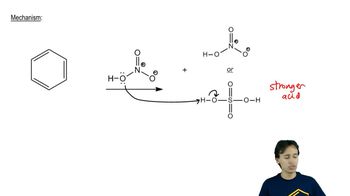
Step 1: Understand the nitration reaction. Nitration is an electrophilic aromatic substitution reaction where a nitro group (-NO₂) is introduced into an aromatic ring. The reaction typically involves concentrated nitric acid (HNO₃) and concentrated sulfuric acid (H₂SO₄) as a catalyst.
Step 2: Analyze the structure of benzenesulfonic acid. Benzenesulfonic acid contains a benzene ring with a sulfonic acid group (-SO₃H) attached. The -SO₃H group is a strong electron-withdrawing group and is meta-directing. This means that the nitro group will preferentially substitute at the meta position relative to the -SO₃H group.
Step 3: Predict the product for benzenesulfonic acid. The nitration of benzenesulfonic acid will result in the formation of meta-nitrobenzenesulfonic acid. The nitro group will attach to the position on the benzene ring that is meta to the -SO₃H group.
Step 4: Analyze the structure of cyclohexylbenzene. Cyclohexylbenzene contains a benzene ring with a cyclohexyl group (-C₆H₁₁) attached. The cyclohexyl group is an electron-donating group through hyperconjugation and inductive effects, making it an ortho/para-directing group. This means that the nitro group will preferentially substitute at the ortho and para positions relative to the -C₆H₁₁ group.
Step 5: Predict the product for cyclohexylbenzene. The nitration of cyclohexylbenzene will result in a mixture of ortho-nitrocyclohexylbenzene and para-nitrocyclohexylbenzene as the major products. The ortho and para positions relative to the -C₆H₁₁ group are the most reactive sites for electrophilic substitution.
Verified video answer for a similar problem:
This video solution was recommended by our tutors as helpful for the problem above
Video duration:
2m
Play a video:
Was this helpful?
Key Concepts
Here are the essential concepts you must grasp in order to answer the question correctly.
Nitration Reaction
Nitration is an electrophilic aromatic substitution reaction where a nitro group (NO2) is introduced into an aromatic compound. This process typically involves the use of a nitrating agent, such as a mixture of concentrated nitric acid and sulfuric acid, which generates the nitronium ion (NO2+), the active electrophile. Understanding the mechanism of nitration is crucial for predicting the products formed when different aromatic compounds are nitrated.
The position of substitution in aromatic compounds is influenced by the existing functional groups on the ring. Electron-donating groups, like alkyl groups, activate the ring and direct substitution to the ortho and para positions, while electron-withdrawing groups, such as sulfonic acid, deactivate the ring and direct substitution to the meta position. Recognizing these patterns is essential for determining the products of nitration for specific substrates.
Different functional groups can significantly affect the reactivity and orientation of electrophilic aromatic substitution reactions. For instance, benzenesulfonic acid contains a sulfonic acid group (-SO3H), which is a strong electron-withdrawing group, while cyclohexylbenzene has an alkyl group that is electron-donating. Understanding these effects helps predict how each compound will react during nitration and what products will be formed.