The following reaction takes place several times faster than the reaction of 2-chlorobutane with HO-: b. Explain why the OH group in the product is not bonded to the carbon that was bonded to the Cl group in the reactant.
Verified step by step guidance
1
Step 1: Analyze the structure of the reactant. The reactant contains a bromine atom bonded to a secondary carbon, and a nearby nitrogen atom with lone pairs. This setup suggests the possibility of an intramolecular reaction due to the proximity of the nucleophilic nitrogen to the electrophilic carbon bonded to bromine.
Step 2: Consider the mechanism of the reaction. The bromine atom is a good leaving group, and the nitrogen atom can act as a nucleophile. The reaction likely proceeds via an intramolecular substitution (S_N2 mechanism), where the nitrogen attacks the carbon bonded to bromine, displacing the bromine and forming a cyclic intermediate.
Step 3: Examine the role of the hydroxide ion (OH⁻). The hydroxide ion acts as a base, deprotonating the cyclic intermediate at the carbon adjacent to the nitrogen. This deprotonation leads to the opening of the ring and the formation of a new bond between the oxygen atom and the carbon that was adjacent to the nitrogen.
Step 4: Explain why the OH group is not bonded to the carbon that was originally bonded to bromine. The intramolecular attack by the nitrogen causes the bromine to leave and forms a cyclic intermediate. The hydroxide ion then reacts with the intermediate, leading to the formation of the final product where the OH group is bonded to a different carbon.
Step 5: Summarize the reaction outcome. The reaction proceeds faster than the reaction of 2-chlorobutane with hydroxide because the intramolecular nucleophilic attack by the nitrogen is highly favorable and reduces the activation energy. The product has the OH group bonded to a carbon that was not originally bonded to bromine due to the rearrangement during the reaction mechanism.
Verified video answer for a similar problem:
This video solution was recommended by our tutors as helpful for the problem above
Video duration:
4m
Play a video:
Was this helpful?
Key Concepts
Here are the essential concepts you must grasp in order to answer the question correctly.
Hofmann Elimination
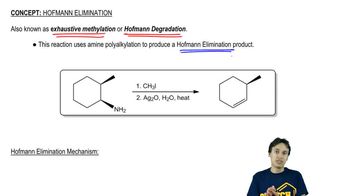
Hofmann elimination is a reaction that involves the conversion of quaternary ammonium salts into alkenes through the elimination of a halide and a proton. This reaction typically occurs under basic conditions, where the hydroxide ion acts as a base, facilitating the removal of the leaving group and forming a double bond. Understanding this mechanism is crucial for analyzing the reaction's products and the positioning of functional groups.
Regioselectivity refers to the preference of a chemical reaction to yield one structural isomer over others when multiple possibilities exist. In the context of the reaction in question, the formation of the OH group on a different carbon than the one initially bonded to the Cl group illustrates regioselectivity, influenced by the stability of the resulting alkene and the mechanism of the elimination process.
Nucleophilic substitution is a fundamental reaction in organic chemistry where a nucleophile replaces a leaving group in a molecule. In this case, the hydroxide ion (OH-) acts as a nucleophile, attacking the carbon atom adjacent to the one that was bonded to the leaving group (Cl). This mechanism helps explain why the OH group ends up on a different carbon, as the reaction pathway favors the formation of a more stable product through the elimination of the leaving group.