Predict the major products formed when the following amines undergo exhaustive methylation, treatment with Ag2O, and heating. (a) hexan-2-amine (b) 2-methylpiperidine (c) N-ethylpiperidine
Verified step by step guidance
1
Step 1: Understand the process of exhaustive methylation. Exhaustive methylation involves treating the amine with excess methyl iodide (CH3I) to convert it into a quaternary ammonium salt. For each amine, identify the nitrogen atom and determine how many methyl groups can be added to it until it becomes a quaternary ammonium ion.
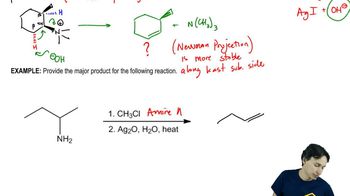
Step 2: Apply the Hofmann elimination reaction. After exhaustive methylation, the quaternary ammonium salt is treated with silver oxide (Ag2O) and water, which generates hydroxide ions (OH⁻). Upon heating, the hydroxide ions induce a β-elimination reaction (Hofmann elimination), leading to the formation of an alkene. Identify the β-hydrogens (hydrogens on the carbon adjacent to the carbon bonded to the nitrogen) and determine the possible alkenes that can form.
Step 3: Predict the major product based on the Hofmann rule. The Hofmann elimination typically favors the formation of the less substituted (less stable) alkene due to steric hindrance in the transition state. For each compound, analyze the possible alkenes and identify the major product based on this rule.
Step 4: For (a) hexan-2-amine, determine the structure of the quaternary ammonium salt after exhaustive methylation. Then, identify the β-hydrogens and predict the major alkene product formed after Hofmann elimination.
Step 5: Repeat the process for (b) 2-methylpiperidine and (c) N-ethylpiperidine. For each compound, determine the quaternary ammonium salt, identify the β-hydrogens, and predict the major alkene product formed after Hofmann elimination, keeping in mind the Hofmann rule.
Verified video answer for a similar problem:
This video solution was recommended by our tutors as helpful for the problem above
Video duration:
6m
Play a video:
Was this helpful?
Key Concepts
Here are the essential concepts you must grasp in order to answer the question correctly.
Exhaustive Methylation
Exhaustive methylation is a chemical process where amines are treated with methylating agents, such as methyl iodide, to convert them into quaternary ammonium salts. This reaction typically involves the complete substitution of hydrogen atoms on the nitrogen atom of the amine with methyl groups, leading to the formation of a fully methylated product. Understanding this concept is crucial for predicting the products of the amines listed in the question.
Silver oxide (Ag2O) is often used in organic chemistry to facilitate the oxidation of amines to their corresponding imines or to promote the elimination of quaternary ammonium salts. When treated with Ag2O, the quaternary ammonium salts formed from exhaustive methylation can undergo dealkylation or rearrangement, leading to the formation of new products. This step is essential for understanding the transformation of the initial methylated amines.
Heating is a common technique in organic chemistry that can drive reactions to completion, promote rearrangements, or facilitate elimination processes. In the context of the question, heating the products formed after exhaustive methylation and Ag2O treatment can lead to further reactions, such as the formation of alkenes or other stable products. Recognizing the role of heat in these reactions is vital for predicting the final products of the amines.