If a quaternary ammonium ion can undergo an elimination reaction with a strong base, why can’t a protonated tertiary amine undergo the same reaction?
Verified step by step guidance
1
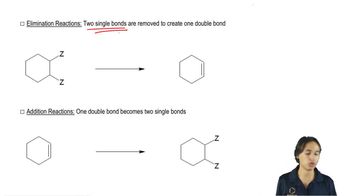
Understand the elimination reaction mechanism: In an elimination reaction, a base removes a proton (H⁺) from a β-carbon, leading to the formation of a double bond (alkene) and the departure of a leaving group. For quaternary ammonium ions, this is known as the Hofmann elimination.
Examine the structure of a quaternary ammonium ion: A quaternary ammonium ion has four alkyl groups attached to a positively charged nitrogen atom (N⁺). The leaving group in this case is a neutral amine (R₃N), which is a stable molecule.
Compare with a protonated tertiary amine: A protonated tertiary amine has three alkyl groups and a hydrogen attached to a positively charged nitrogen atom (N⁺H). If this were to undergo elimination, the leaving group would be NH₃⁺ (ammonium ion), which is not stable and does not readily leave.
Consider the stability of the leaving group: The success of an elimination reaction depends on the ability of the leaving group to stabilize itself after departure. In the case of quaternary ammonium ions, the leaving group (R₃N) is neutral and stable, whereas NH₃⁺ from a protonated tertiary amine is highly unstable.
Conclude why protonated tertiary amines cannot undergo elimination: Due to the instability of the NH₃⁺ leaving group, protonated tertiary amines are not suitable for elimination reactions. This is a key difference from quaternary ammonium ions, which can undergo Hofmann elimination due to their stable leaving group.
Verified video answer for a similar problem:
This video solution was recommended by our tutors as helpful for the problem above
Video duration:
4m
Play a video:
Was this helpful?
Key Concepts
Here are the essential concepts you must grasp in order to answer the question correctly.
Quaternary Ammonium Ion Structure
A quaternary ammonium ion is a positively charged species with four organic groups attached to a nitrogen atom. This structure makes it stable and allows it to participate in elimination reactions, particularly when a strong base is present. The presence of the positive charge facilitates the removal of a leaving group, leading to the formation of alkenes.
A protonated tertiary amine is a nitrogen-containing compound where the nitrogen atom has three organic groups and carries a positive charge due to the addition of a proton (H+). Unlike quaternary ammonium ions, protonated tertiary amines are less stable for elimination reactions because they lack a suitable leaving group and the steric hindrance from the bulky groups makes it difficult for the base to abstract a proton.
Elimination reactions involve the removal of atoms or groups from a molecule, resulting in the formation of a double bond. In the case of quaternary ammonium ions, the strong base can facilitate this process by removing a proton adjacent to the leaving group. However, for protonated tertiary amines, the reaction is hindered due to the lack of a good leaving group and the unfavorable sterics, preventing the formation of a double bond.