Textbook Question
b. Which step is the rate-determining step?
1031
views

 Bruice 8th EditionCh. 6 - The Reactions of Alkenes • The Stereochemistry of Addition ReactionsProblem 74c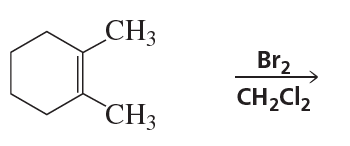
 Verified step by step guidance
 09:23
09:23
 01:58
01:58 05:09
05:09b. Which step is the rate-determining step?
A student was about to turn in the products he had obtained from the reaction of HI with 3,3,3-trifluoropropene when he realized that the labels had fallen off his flasks and he did not know which label belonged to which flask. His friend reminded him of the rule that says the electrophile adds to the sp2 carbon bonded to the most hydrogens. In other words, he should label the flask containing the most product 1,1,1-trifluoro-2-iodopropane and label the flask containing the least amount of product 1,1,1-trifluoro-3-iodopropane. Should he follow his friend’s advice?
a. Propose a mechanism for the following reaction (show all curved arrows):
The second-order rate constant (in units of M-1s-1) for acid-catalyzed hydration at 25 °C is given for each of the following alkenes:
a. Calculate the relative rates of hydration of the alkenes. (Hint: Divide each rate constant by the smallest rate constant of the series: 3.51 × 10⁻⁸.)
b. Why does (Z)-2-butene react faster than (E)-2-butene?
c. Why does 2-methyl-2-butene react faster than (Z)-2-butene?
d. Why does 2,3-dimethyl-2-butene react faster than 2-methyl-2-butene?
1-Methylcyclohexene forms two products when it reacts with bromine in methanol.
a. Draw the mechanism for the formation of the products.
b. Describe their stereochemical relationship—that is, are they enantiomers or diastereomers?
Draw the products of the following reactions. If the products can exist as stereoisomers, show which stereoisomers are formed.
b.