The IR and mass spectra for three different compounds are shown below. Identify each compound. c. <IMAGE>
Verified step by step guidance
1
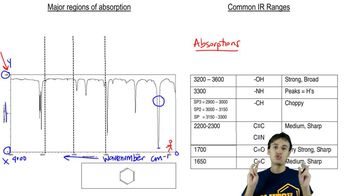
Step 1: Analyze the IR spectrum for each compound. Look for key absorption bands that indicate the presence of functional groups. For example, a broad peak around 3200-3600 cm⁻¹ suggests an -OH group, while a sharp peak near 1700 cm⁻¹ indicates a carbonyl group (C=O).
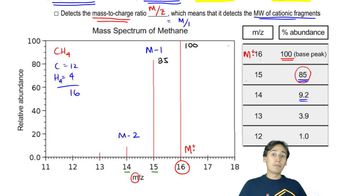
Step 2: Examine the mass spectrum for each compound. Identify the molecular ion peak (M⁺) to determine the molecular weight of the compound. Look for fragmentation patterns that can provide clues about the structure of the molecule.
Step 3: Correlate the functional groups identified in the IR spectrum with the molecular weight and fragmentation patterns observed in the mass spectrum. This will help narrow down the possible structures of the compounds.
Step 4: Consider the chemical context or any additional information provided in the problem (e.g., molecular formula, degree of unsaturation). Use this to further refine your identification of each compound.
Step 5: Propose a structure for each compound based on the combined analysis of the IR and mass spectra. Verify that the proposed structures are consistent with all the spectral data provided.
Verified video answer for a similar problem:
This video solution was recommended by our tutors as helpful for the problem above
Video duration:
3m
Play a video:
Was this helpful?
Key Concepts
Here are the essential concepts you must grasp in order to answer the question correctly.
Infrared Spectroscopy (IR)
Infrared spectroscopy is a technique used to identify functional groups in organic compounds by measuring the absorption of infrared light. Different bonds absorb characteristic frequencies of IR radiation, resulting in a spectrum that displays peaks corresponding to these absorptions. By analyzing the positions and intensities of these peaks, one can deduce the presence of specific functional groups, aiding in compound identification.
Mass spectrometry is an analytical technique that measures the mass-to-charge ratio of ions to identify and quantify molecules in a sample. In this process, compounds are ionized and fragmented, producing a spectrum that displays the mass of the parent ion and its fragments. The resulting mass spectrum provides information about the molecular weight and structure of the compound, which is crucial for identification.
Compound identification involves using analytical techniques like IR and MS to determine the identity of unknown substances. By comparing the obtained spectra with known reference data, chemists can deduce the structure and functional groups present in the compounds. This process is essential in organic chemistry for characterizing new compounds and confirming their identities in research and industry.