
Classify the following objects and molecules as chiral or achiral. (a) <IMAGE>
Verified step by step guidance
1
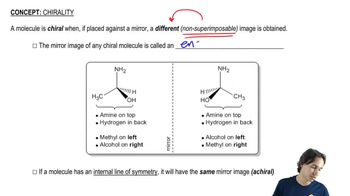
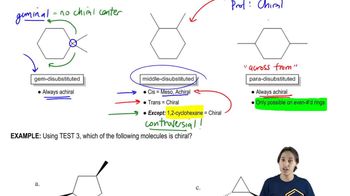
Step 1: Understand the concept of chirality. A molecule or object is chiral if it cannot be superimposed on its mirror image. This typically occurs when a carbon atom is bonded to four different groups, creating a stereocenter. If the molecule has a plane of symmetry or can be superimposed on its mirror image, it is achiral.
Step 2: Examine the structure of the molecule or object provided in the image. Identify any carbon atoms that are bonded to four different groups. These are potential stereocenters and indicate chirality.
Step 3: Check for symmetry in the molecule. If the molecule has a plane of symmetry or a center of symmetry, it is likely achiral. Use visualization or molecular models if necessary to confirm.
Step 4: Determine whether the molecule can be superimposed on its mirror image. If it cannot, classify it as chiral. If it can, classify it as achiral.
Step 5: Based on the analysis, classify the given molecule or object as either chiral or achiral. Ensure that you clearly justify your reasoning for the classification.
Verified video answer for a similar problem:
This video solution was recommended by our tutors as helpful for the problem above
Play a video:
Was this helpful?
Key Concepts
Here are the essential concepts you must grasp in order to answer the question correctly.
Chirality
Chirality refers to the geometric property of a molecule that makes it non-superimposable on its mirror image. A chiral molecule typically has at least one carbon atom bonded to four different substituents, creating two distinct forms known as enantiomers. These enantiomers can exhibit different optical activities, meaning they rotate plane-polarized light in opposite directions.
Achirality describes molecules that are superimposable on their mirror images, meaning they do not have a chiral center. Such molecules may have symmetry elements, such as a plane of symmetry or a center of symmetry, which allow them to be identical to their mirror images. Common examples include molecules like ethane or any symmetrical compound.
Stereoisomerism is a form of isomerism where molecules have the same molecular formula and connectivity of atoms but differ in the spatial arrangement of their atoms. This category includes both enantiomers (chiral) and diastereomers (not mirror images). Understanding stereoisomerism is crucial for classifying molecules as chiral or achiral, as it directly relates to their three-dimensional structure.