
Textbook Question
Classify the following objects and molecules as chiral or achiral.
(a) <IMAGE>
1050
views

 Verified step by step guidance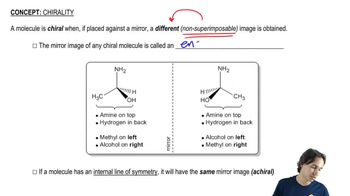
 05:10
05:10
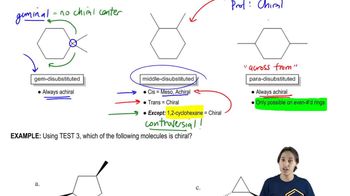 04:48
04:48 01:58
01:58Classify the following objects and molecules as chiral or achiral.
(a) <IMAGE>
We discuss the reaction of Grignard reagents (organomagnesium compounds) to ketones in Chapter 17. Mechanistically, the reaction proceeds by the nucleophilic addition of a methyl carbanion to the electrophilic carbon of the carbonyl, breaking the C―Oπ bond, resulting in an alkoxide intermediate that is subsequently protonated to produce the 3° alcohol.
(b) Why, when the substrate is modified slightly, does the reaction result in an excess of one stereoisomer?
Classify the following objects and molecules as chiral or achiral.
(k)
Classify the following objects and molecules as chiral or achiral.
(e)
Classify the following objects and molecules as chiral or achiral.
(h)
We discuss the reaction of Grignard reagents (organomagnesium compounds) to ketones in Chapter 17. Mechanistically, the reaction proceeds by the nucleophilic addition of a methyl carbanion to the electrophilic carbon of the carbonyl, breaking the C―Oπ bond, resulting in an alkoxide intermediate that is subsequently protonated to produce the 3° alcohol.
(a) Why does this reaction produce a racemic mixture of 3° alcohols?