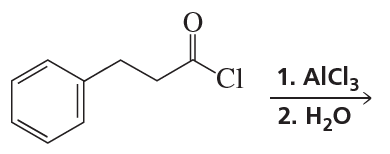
What are the products of the following reactions? a.
Verified step by step guidance
1
Analyze the given reactant structure: The molecule contains a benzene ring attached to a side chain with a tertiary carbon and two methyl groups.
Identify the reagent: H₂CrO₄ (chromic acid) is a strong oxidizing agent, typically used to oxidize primary and secondary alcohols, as well as benzylic carbons.
Determine the reaction site: The benzylic position (the carbon directly attached to the benzene ring) is susceptible to oxidation by chromic acid, especially if it has hydrogen atoms attached.
Predict the product: Chromic acid will oxidize the benzylic carbon to a carboxylic acid group, replacing the entire side chain beyond the benzylic carbon with a -COOH group.
Conclude the reaction: The final product will be benzoic acid, as the benzylic carbon is oxidized to a carboxylic acid group, and the rest of the side chain is removed.
Verified video answer for a similar problem:
This video solution was recommended by our tutors as helpful for the problem above
Video duration:
2m
Play a video:
Was this helpful?
Key Concepts
Here are the essential concepts you must grasp in order to answer the question correctly.
Oxidation of Aromatic Compounds
Aromatic compounds can undergo oxidation reactions, where the addition of oxygen or the removal of hydrogen occurs. In this case, the presence of H2CrO4, a strong oxidizing agent, facilitates the oxidation of the side chain of the aromatic compound, typically converting alkyl groups into carbonyl groups or carboxylic acids, depending on the structure and conditions.
Chromic acid (H2CrO4) is a powerful oxidizing agent commonly used in organic chemistry to oxidize alcohols, aldehydes, and side chains of aromatic compounds. It can convert primary alcohols to carboxylic acids and secondary alcohols to ketones, making it essential for understanding the products of oxidation reactions involving aromatic compounds.
Electrophilic aromatic substitution (EAS) is a fundamental reaction mechanism in organic chemistry where an electrophile replaces a hydrogen atom on an aromatic ring. Understanding EAS is crucial for predicting the outcomes of reactions involving aromatic compounds, especially when considering how substituents on the ring can influence the reactivity and orientation of further reactions.