What do the results of parts (a) and (b) imply about the hemiacetal structure of fructose?
Verified step by step guidance
1
Understand the context: Fructose is a monosaccharide that can exist in both linear and cyclic forms. The cyclic form is created when the hydroxyl group (-OH) on one carbon reacts with the carbonyl group (C=O) on another carbon, forming a hemiacetal or hemiketal structure.
Review the results of parts (a) and (b): Analyze the data or observations provided in parts (a) and (b) to determine whether they support the presence of a hemiacetal structure in fructose. For example, if part (a) involves a reaction with an alcohol and part (b) involves hydrolysis, these could provide evidence of a hemiacetal group.
Recall the properties of hemiacetals: Hemiacetals are typically unstable in aqueous solutions unless they are part of a cyclic structure. If the results of parts (a) and (b) indicate stability or specific reactivity, this could imply that fructose exists predominantly in its cyclic hemiacetal form.
Correlate the experimental results with the structure: If the results of parts (a) and (b) show reactivity consistent with a hemiacetal (e.g., reaction with an acid or base, or formation of a glycosidic bond), this supports the conclusion that fructose adopts a cyclic hemiacetal structure.
Conclude based on the evidence: Summarize how the results of parts (a) and (b) confirm or suggest the presence of a hemiacetal structure in fructose. Highlight the importance of the cyclic form in the behavior and reactivity of fructose.
Verified video answer for a similar problem:
This video solution was recommended by our tutors as helpful for the problem above
Video duration:
4m
Play a video:
Was this helpful?
Key Concepts
Here are the essential concepts you must grasp in order to answer the question correctly.
Hemiacetal Formation
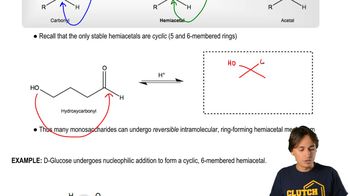
A hemiacetal is formed when an alcohol reacts with an aldehyde or ketone, resulting in a compound that contains both an alcohol and an ether functional group. In the case of sugars like fructose, this reaction is crucial for the interconversion between the open-chain and cyclic forms of the molecule, which is essential for understanding its structure and reactivity.
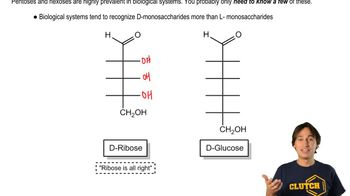
Fructose is a ketohexose, meaning it has six carbon atoms and a ketone functional group. Its structure can exist in an open-chain form or as a cyclic hemiacetal, where the carbonyl group reacts with a hydroxyl group on the same molecule. This cyclic form is more stable and is the predominant structure in solution, influencing its chemical behavior and interactions.
The anomeric carbon is the carbon atom in a sugar that was originally part of the carbonyl group and becomes a new chiral center upon cyclization. In fructose, the anomeric carbon plays a critical role in determining the properties of the hemiacetal structure, including its reactivity and the formation of different anomers, which can affect biological interactions and functions.