Show the product that results when fructose is treated with an excess of methyl iodide and silver oxide.
Verified step by step guidance
1
Identify the functional groups in fructose: Fructose is a monosaccharide with a ketone group (ketose) and multiple hydroxyl (-OH) groups. These hydroxyl groups are reactive and can undergo methylation.
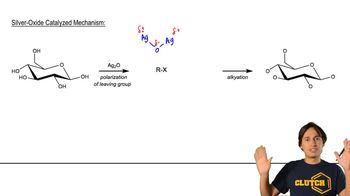
Understand the role of methyl iodide (CH3I) and silver oxide (Ag2O): Methyl iodide is a methylating agent, and silver oxide acts as a base to facilitate the reaction. Together, they replace the hydrogen atoms of hydroxyl groups with methyl groups (-CH3).
Determine the reaction mechanism: Each hydroxyl group in fructose reacts with methyl iodide in the presence of silver oxide to form a methoxy group (-OCH3). This process is repeated for all hydroxyl groups, as the reaction is carried out with an excess of methyl iodide.
Account for the ketone group: The ketone group in fructose does not react with methyl iodide under these conditions, so it remains unchanged in the product.
Draw the final product: The final product is a fully methylated derivative of fructose, where all hydroxyl groups are converted to methoxy groups (-OCH3), and the ketone group remains intact. Represent this structure clearly, ensuring all substituents are shown.
Verified video answer for a similar problem:
This video solution was recommended by our tutors as helpful for the problem above
Video duration:
2m
Play a video:
Was this helpful?
Key Concepts
Here are the essential concepts you must grasp in order to answer the question correctly.
Fructose Structure and Reactivity
Fructose is a monosaccharide with a ketone functional group and multiple hydroxyl groups. Its structure allows it to undergo various chemical reactions, including alkylation. Understanding the specific sites of reactivity in fructose is crucial for predicting the products formed when it reacts with reagents like methyl iodide.
Alkylation is a chemical reaction where an alkyl group is transferred to a nucleophile. In this case, methyl iodide acts as the alkylating agent, providing a methyl group that can attach to the hydroxyl groups of fructose. Recognizing how alkylation modifies the structure of fructose is essential for determining the final product.
Silver oxide serves as a base in this reaction, facilitating the deprotonation of the hydroxyl groups on fructose. This increases the nucleophilicity of the hydroxyl groups, making them more reactive towards methyl iodide. Understanding the role of silver oxide helps clarify how it influences the reaction mechanism and product formation.