Draw a structure for each of the following: a. N,N-dimethylhexanamide
Verified step by step guidance
1
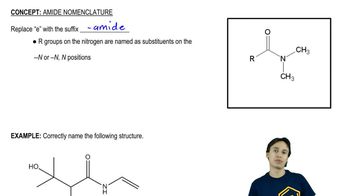
Step 1: Understand the name of the compound. The name 'N,N-dimethylhexanamide' indicates that the compound is an amide (contains a -CONH- group) with a hexane backbone (6 carbon atoms in the main chain). The 'N,N-dimethyl' prefix means there are two methyl groups attached to the nitrogen atom of the amide group.
Step 2: Start by drawing the hexane backbone. Hexane is a straight-chain alkane with six carbon atoms connected by single bonds. Represent this as CH3-CH2-CH2-CH2-CH2-CH3.
Step 3: Identify the amide functional group. Replace the terminal hydrogen atom of one of the carbons in the hexane chain with a -CONH- group. This creates the amide functional group.
Step 4: Add the N,N-dimethyl substituents. Attach two methyl groups (-CH3) to the nitrogen atom of the amide group. This completes the 'N,N-dimethyl' part of the name.
Step 5: Verify the structure. Ensure that all valencies are satisfied, and the structure matches the IUPAC name 'N,N-dimethylhexanamide'. The final structure should have a hexane chain with a -CON(CH3)2 group attached to one end.
Verified video answer for a similar problem:
This video solution was recommended by our tutors as helpful for the problem above
Video duration:
3m
Play a video:
Was this helpful?
Key Concepts
Here are the essential concepts you must grasp in order to answer the question correctly.
Amides
Amides are organic compounds derived from carboxylic acids where the hydroxyl group is replaced by an amine group. They have the general structure R1R2N-C(=O)-R3, where R1, R2, and R3 can be hydrogen or hydrocarbon chains. Amides are important in organic chemistry due to their presence in proteins and their use in various synthetic processes.
N,N-Dimethyl substitution refers to the presence of two methyl groups attached to the nitrogen atom of an amide. This substitution affects the physical and chemical properties of the amide, such as its boiling point and solubility. Understanding this substitution is crucial for accurately drawing the structure of N,N-dimethylhexanamide.
Synthesis of Amino Acids: N-Phthalimidomalonic Ester Synthesis Concept 1
Hexanamide Structure
Hexanamide is an amide derived from hexanoic acid, which has a six-carbon chain. The structure of hexanamide includes a carbonyl group (C=O) bonded to a nitrogen atom, which is further bonded to the hexyl chain. Recognizing the carbon chain length and the functional groups involved is essential for correctly constructing the molecular structure of N,N-dimethylhexanamide.