Draw a structure for each of the following: b. 3,3-dimethylhexanamide
Verified step by step guidance
1
Identify the parent chain: The parent chain is 'hexanamide,' which indicates a six-carbon chain (hexane) with an amide functional group (-CONH2) at the terminal carbon.
Number the carbon chain: Start numbering the chain from the carbon of the amide group (C1) to ensure the functional group gets the lowest possible number.
Locate the substituents: The name '3,3-dimethyl' indicates that there are two methyl groups (-CH3) attached to the third carbon of the parent chain.
Draw the structure: Begin by drawing the six-carbon chain with the amide group (-CONH2) at C1. Then, add two methyl groups to C3 of the chain.
Verify the structure: Ensure that the structure matches the IUPAC name, with the correct placement of the amide group and substituents, and that all carbons have the correct number of bonds (four for carbon).
Verified video answer for a similar problem:
This video solution was recommended by our tutors as helpful for the problem above
Video duration:
3m
Play a video:
Was this helpful?
Key Concepts
Here are the essential concepts you must grasp in order to answer the question correctly.
IUPAC Nomenclature
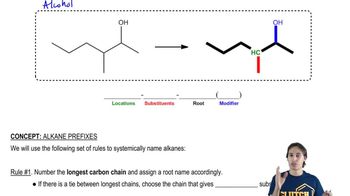
IUPAC nomenclature is a systematic method for naming organic chemical compounds. It provides rules for identifying the structure of a compound based on its molecular formula and functional groups. Understanding the naming conventions, such as identifying the longest carbon chain and substituents, is essential for accurately drawing chemical structures.
Functional groups are specific groups of atoms within molecules that are responsible for the characteristic chemical reactions of those molecules. In the case of amides, the functional group is characterized by a carbonyl group (C=O) directly attached to a nitrogen atom (N). Recognizing functional groups helps in understanding the reactivity and properties of the compound.
Structural representation refers to the way in which a chemical compound is depicted, showing the arrangement of atoms and the bonds between them. For 3,3-dimethylhexanamide, it is important to accurately represent the carbon backbone, the amide functional group, and the positions of the methyl substituents. This visual representation aids in comprehending the compound's geometry and potential reactivity.