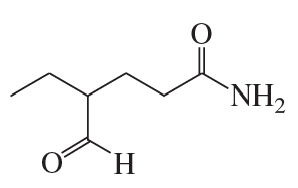
Step 1: Identify the functional groups in the molecule. The structure contains a ketone group (C=O), an aldehyde group (-CHO), and an amide group (-CONH2). These functional groups will influence the naming of the compound.
Step 2: Determine the longest carbon chain that includes the highest-priority functional group. The aldehyde group (-CHO) has the highest priority according to IUPAC rules, so the chain must include this group.
Step 3: Number the carbon chain starting from the end closest to the highest-priority functional group (aldehyde). Assign numbers to the substituents and other functional groups based on their position in the chain.
Step 4: Name the substituents and other functional groups. The ketone group will be named as an oxo substituent, and the amide group will be named as an amido substituent. The alkyl groups attached to the chain will also be named.
Step 5: Combine the names of the substituents, functional groups, and the parent chain into the full IUPAC name, ensuring proper placement of locants and prefixes.
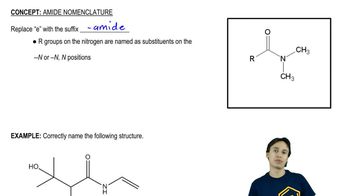
Verified video answer for a similar problem:
This video solution was recommended by our tutors as helpful for the problem above
Video duration:
6m
Play a video:
Was this helpful?
Key Concepts
Here are the essential concepts you must grasp in order to answer the question correctly.
Amides
Amides are organic compounds derived from carboxylic acids where the hydroxyl group (-OH) is replaced by an amine or ammonia group (-NH2). They are characterized by the functional group -C(=O)N-, which is crucial for their chemical properties and reactivity. Amides can be primary, secondary, or tertiary depending on the number of carbon-containing groups attached to the nitrogen atom.
The nomenclature of organic compounds follows specific rules set by the International Union of Pure and Applied Chemistry (IUPAC). For amides, the naming convention typically involves identifying the longest carbon chain attached to the carbonyl group, followed by the suffix '-amide.' Substituents and their positions are indicated using prefixes and numbers, ensuring clarity in the compound's structure.
Functional groups are specific groups of atoms within molecules that are responsible for the characteristic chemical reactions of those molecules. In the case of amides, the carbonyl group (C=O) and the amine group (N-H) are the key functional groups that define their reactivity and properties. Understanding functional groups is essential for predicting the behavior of organic compounds in chemical reactions.