Determine the ratios of the chemically nonequivalent protons in a compound if the steps of the integration curves measure 40.5, 27, 13, and 118 mm, from left to right across the spectrum. Draw the structure of a compound whose 1H NMR spectrum would show these integrals in the observed order.
Verified step by step guidance
1
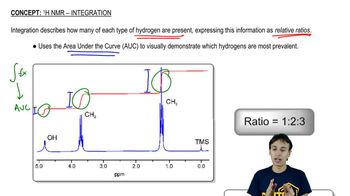
Step 1: Analyze the integration curve values provided (40.5 mm, 27 mm, 13 mm, and 118 mm). These values represent the relative areas under the peaks in the 1H NMR spectrum, which correspond to the number of chemically nonequivalent protons in the molecule.
Step 2: Divide each integration value by the smallest value (13 mm) to normalize the ratios. This will give the relative number of protons contributing to each peak.
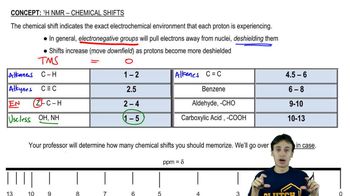
Step 3: Identify the chemical environment of the protons in the molecule. For example, in alcohols, the hydroxyl (-OH) group typically appears as a singlet, while alkyl groups contribute to multiplets depending on their connectivity and neighboring groups.
Step 4: Based on the normalized ratios, assign the peaks to specific groups of protons in the molecule. For instance, a CH3 group contributes 3 protons, a CH2 group contributes 2 protons, and a CH group contributes 1 proton.
Step 5: Draw the structure of a compound that matches the observed integration ratios and chemical environments. For example, a molecule like 2-methyl-1-propanol or 1-butanol could fit the given data, depending on the exact proton environments.
Verified video answer for a similar problem:
This video solution was recommended by our tutors as helpful for the problem above
Video duration:
3m
Play a video:
Was this helpful?
Key Concepts
Here are the essential concepts you must grasp in order to answer the question correctly.
Integration in NMR Spectroscopy
Integration in NMR spectroscopy refers to the area under the peaks in the spectrum, which correlates to the number of protons contributing to that signal. The height or area of each peak is proportional to the number of chemically equivalent protons in the molecule. By measuring these areas, one can determine the relative ratios of different types of protons in the compound.
Chemically nonequivalent protons are protons that are in different chemical environments within a molecule, leading to distinct NMR signals. These differences arise from variations in the electronic environment surrounding the protons, which can be influenced by factors such as electronegativity of nearby atoms and molecular geometry. Understanding which protons are nonequivalent is crucial for interpreting NMR spectra accurately.
Chemical Reactions of Phosphate Anhydrides Concept 1
Chemical Structure and NMR Interpretation
The chemical structure of a compound directly influences its NMR spectrum, as the arrangement of atoms affects the magnetic environment of protons. Drawing the correct structure based on integration values requires knowledge of how different functional groups and molecular frameworks contribute to the observed signals. For instance, the presence of an alcohol group can lead to specific shifts and integrations in the NMR spectrum, which must be considered when deducing the compound's structure.