Join thousands of students who trust us to help them ace their exams!
Multiple Choice
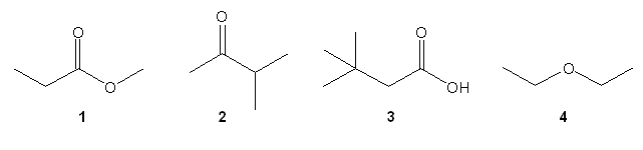
Which of the following molecules gives a 1H NMR spectrum consisting of three peaks with integral ratio of 3:1:6 (when signals are counted from left to right)?
A
1
B
2
C
3
D
4
7 Comments
Verified step by step guidance
1
Identify the number of unique hydrogen environments in each molecule. This will help determine the number of peaks in the 1H NMR spectrum.
For molecule 1, ethyl acetate, there are three unique hydrogen environments: the methyl group (CH3) attached to the oxygen, the methylene group (CH2) next to the carbonyl, and the methyl group (CH3) next to the methylene.
For molecule 2, isopropyl acetate, there are three unique hydrogen environments: the methyl groups (CH3) attached to the carbonyl, the methine group (CH) next to the carbonyl, and the methyl groups (CH3) attached to the methine.
For molecule 3, 2-methylpropanoic acid, there are four unique hydrogen environments: the methyl groups (CH3) attached to the carbon, the methine group (CH) next to the carbonyl, the methylene group (CH2) next to the hydroxyl, and the hydroxyl group (OH).
For molecule 4, diethyl ether, there are two unique hydrogen environments: the methylene groups (CH2) next to the oxygen and the methyl groups (CH3) attached to the methylene. Compare the integral ratios of the peaks to the given ratio of 3:1:6 to determine the correct molecule.


 Verified step by step guidance

