
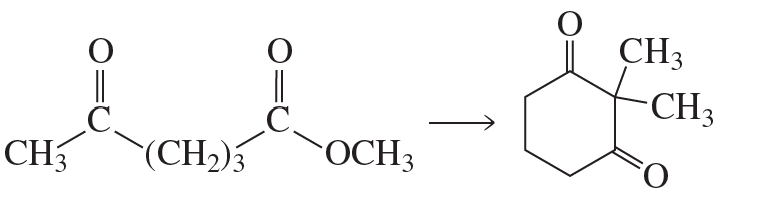
Indicate how each of the following compounds can be synthesized from the given starting material and any other necessary reagents: b.
Verified step by step guidance
1
Step 1: Analyze the starting material and the target compound. The starting material is a β-keto ester (ethyl acetoacetate), and the target compound is a bicyclic diketone. This suggests a reaction involving cyclization and formation of two new carbon-carbon bonds.
Step 2: Recognize that the transformation likely involves an intramolecular aldol condensation. This reaction requires the generation of an enolate ion from the β-keto ester under basic conditions, which will then attack another carbonyl group within the molecule.
Step 3: Treat the starting material with a strong base, such as sodium ethoxide (NaOEt), to deprotonate the α-hydrogen of the β-keto ester and form the enolate ion. The enolate ion is nucleophilic and can initiate the cyclization process.
Step 4: The enolate ion attacks the carbonyl group of the ester, forming a new carbon-carbon bond and creating a cyclic intermediate. This intermediate undergoes elimination of ethanol to form the bicyclic diketone structure.
Step 5: After the reaction is complete, the product can be isolated and purified using standard techniques such as recrystallization or chromatography to obtain the desired bicyclic diketone.
Verified video answer for a similar problem:
This video solution was recommended by our tutors as helpful for the problem above
Video duration:
3m
Play a video:
Was this helpful?
Key Concepts
Here are the essential concepts you must grasp in order to answer the question correctly.
Claisen Condensation
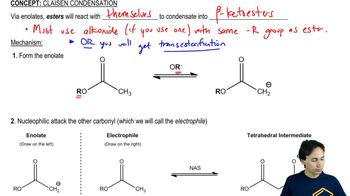
Claisen condensation is a reaction between two esters or an ester and a carbonyl compound in the presence of a strong base, leading to the formation of a β-keto ester or a β-diketone. This reaction involves the nucleophilic attack of an enolate ion on the carbonyl carbon of another ester, followed by the elimination of an alcohol. Understanding this mechanism is crucial for synthesizing complex cyclic structures from simpler precursors.
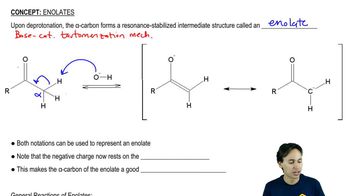
Enolate ions are formed when a strong base abstracts a proton from the alpha carbon of a carbonyl compound, resulting in a resonance-stabilized anion. This species is a key intermediate in many organic reactions, including the Claisen condensation. Recognizing how to generate and utilize enolate ions is essential for predicting the outcomes of reactions involving carbonyl compounds.
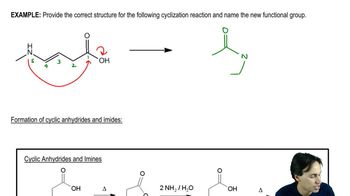
Cyclization reactions involve the formation of cyclic compounds from acyclic precursors, often through intramolecular reactions. In the context of the Claisen condensation, cyclization can occur when the reaction leads to the formation of a ring structure, as seen in the provided reaction diagram. Understanding the conditions that favor cyclization, such as sterics and electronics, is important for successful synthesis.