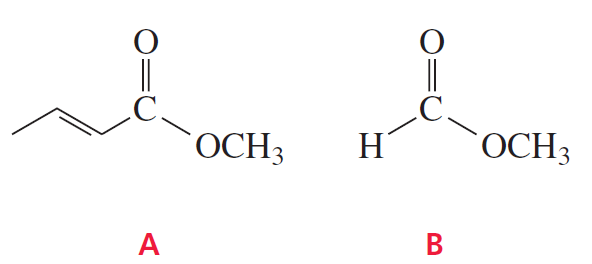
Which of the following esters cannot undergo a Claisen condensation?
Verified step by step guidance
1
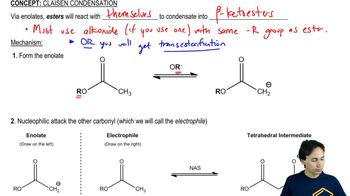
Step 1: Recall the requirements for a Claisen condensation. Claisen condensation involves the reaction of two ester molecules or one ester and one ketone molecule in the presence of a strong base, typically an alkoxide. The reaction requires the ester to have at least one alpha-hydrogen (a hydrogen atom attached to the carbon adjacent to the carbonyl group). This alpha-hydrogen is necessary for enolate formation, which is a key intermediate in the reaction.
Step 2: Analyze the structure of ester A. Ester A has an alpha-carbon with hydrogens attached, making it capable of forming an enolate. Therefore, ester A can undergo Claisen condensation.
Step 3: Analyze the structure of ester B. Ester B also has an alpha-carbon with hydrogens attached, allowing enolate formation. Thus, ester B can undergo Claisen condensation.
Step 4: Analyze the structure of ester C. Ester C has an alpha-carbon with hydrogens attached, which means it can form an enolate and participate in Claisen condensation.
Step 5: Analyze the structure of ester D. Ester D has a nitro group (-NO2) attached to the aromatic ring. This electron-withdrawing group significantly reduces the acidity of the alpha-hydrogens, making enolate formation difficult or impossible. Therefore, ester D cannot undergo Claisen condensation.
Verified video answer for a similar problem:
This video solution was recommended by our tutors as helpful for the problem above
Video duration:
6m
Play a video:
Was this helpful?
Key Concepts
Here are the essential concepts you must grasp in order to answer the question correctly.
Claisen Condensation
Claisen condensation is a reaction between two esters or an ester and a carbonyl compound in the presence of a strong base, leading to the formation of a β-keto ester or a β-diketone. This reaction requires at least one of the reactants to have an alpha hydrogen, which is essential for the formation of the enolate ion that initiates the reaction.
Alpha hydrogens are the hydrogen atoms attached to the carbon atom adjacent to a carbonyl group. Their presence is crucial for reactions like Claisen condensation, as they can be deprotonated by a strong base to form an enolate ion, which is a reactive intermediate that facilitates the condensation process.
Steric hindrance refers to the repulsion between bulky groups in a molecule that can impede chemical reactions. In the context of Claisen condensation, steric hindrance can prevent the formation of the enolate ion or hinder the approach of reactants, making certain esters less reactive or unable to participate in the reaction.