Draw the products of the following reactions: a. diethyl heptanedioate: (1) sodium ethoxide; (2) HCl
Verified step by step guidance
1
Step 1: Analyze the structure of diethyl heptanedioate. It contains two ester groups (-COOEt) attached to a heptane backbone. The reaction involves two steps: (1) treatment with sodium ethoxide (CH3O⁻), a strong base, and (2) acidification with HCl.
Step 2: In the first step, sodium ethoxide acts as a base and deprotonates the alpha-hydrogen (hydrogen adjacent to the ester group). This generates an enolate ion, which is stabilized by resonance between the alpha-carbon and the carbonyl group.
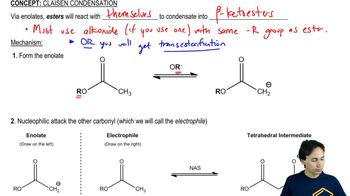
Step 3: The enolate ion undergoes intramolecular nucleophilic attack on the second ester group, leading to the formation of a cyclic intermediate. This step is a key part of the Dieckmann condensation reaction, which forms a β-keto ester.
Step 4: In the second step, the reaction mixture is acidified with HCl. This protonates the intermediate and stabilizes the β-keto ester product. Additionally, any remaining ethoxide ions are neutralized.
Step 5: The final product is a cyclic β-keto ester, which is formed as a result of the Dieckmann condensation. The exact structure depends on the specific positions of the ester groups in the starting material.
Verified video answer for a similar problem:
This video solution was recommended by our tutors as helpful for the problem above
Video duration:
3m
Play a video:
Was this helpful?
Key Concepts
Here are the essential concepts you must grasp in order to answer the question correctly.
Claisen Condensation
Claisen condensation is a reaction between two esters or an ester and a carbonyl compound in the presence of a strong base, leading to the formation of a β-keto ester or a β-diketone. In this process, the base deprotonates the alpha hydrogen of one ester, allowing it to act as a nucleophile and attack the carbonyl carbon of another ester, resulting in a new carbon-carbon bond.
Sodium ethoxide (NaOEt) is a strong base commonly used in organic synthesis, particularly in reactions like the Claisen condensation. It effectively deprotonates the alpha hydrogen of esters, generating an enolate ion that can participate in nucleophilic attacks on carbonyl compounds, facilitating the formation of larger carbon skeletons.
An acid workup, typically involving a reagent like HCl, is performed after a reaction to protonate any negatively charged species formed during the reaction. In the context of Claisen condensation, the acid workup neutralizes the base and helps to stabilize the product by converting the enolate back to a carbonyl compound, ensuring the final product is in its desired form.