Propose structures that are consistent with the following spectra. (Integral ratios are given from left to right across the spectrum.) b. The 1H NMR spectrum of a compound with molecular formula C6H10O2 has two singlets with integral ratios of 2 : 3.
Verified step by step guidance
1
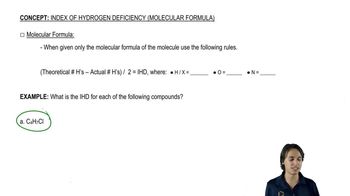
Analyze the molecular formula (C6H10O2): Calculate the degree of unsaturation using the formula: \( \text{Degree of Unsaturation} = \frac{2C + 2 - H + N - X}{2} \), where C = 6, H = 10, O = 2, and there are no halogens (X) or nitrogens (N). This will help determine the presence of double bonds, rings, or aromatic systems.
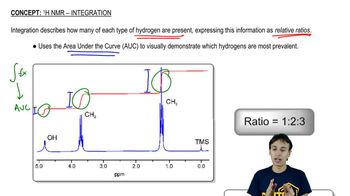
Interpret the 1H NMR data: The spectrum shows two singlets with integral ratios of 2:3. A singlet indicates that the protons are not coupled to any neighboring protons, suggesting isolated groups. The ratio of 2:3 suggests two distinct environments for the protons, with one group containing 2 protons and the other containing 3 protons.
Consider functional groups: The molecular formula includes oxygen atoms, which could indicate the presence of functional groups such as esters, ketones, or alcohols. The singlet signals suggest that the protons are likely part of groups like methyl (CH3) or methylene (CH2) attached to electronegative atoms or within symmetrical environments.
Propose possible structures: Based on the degree of unsaturation and the NMR data, consider structures that include an ester functional group (common for compounds with oxygen and singlet signals). For example, a structure with a methyl group (CH3) and a methylene group (CH2) adjacent to an ester group could fit the data.
Verify the structure: Ensure that the proposed structure matches the molecular formula (C6H10O2), the degree of unsaturation, and the NMR data (two singlets with integral ratios of 2:3). Adjust the structure if necessary to account for all spectral and molecular information.
Verified video answer for a similar problem:
This video solution was recommended by our tutors as helpful for the problem above
Video duration:
8m
Play a video:
Was this helpful?
Key Concepts
Here are the essential concepts you must grasp in order to answer the question correctly.
1H NMR Spectroscopy
1H NMR (Proton Nuclear Magnetic Resonance) spectroscopy is a powerful analytical technique used to determine the structure of organic compounds. It provides information about the number of hydrogen atoms in different environments within a molecule. The chemical shifts, multiplicity, and integration of the signals help identify functional groups and the connectivity of atoms.
Integral ratios in NMR spectroscopy indicate the relative number of protons contributing to each signal. In this case, a ratio of 2:3 suggests that one signal corresponds to two equivalent protons, while the other corresponds to three equivalent protons. This information is crucial for deducing the molecular structure and identifying how many hydrogen atoms are associated with specific carbon atoms.
The molecular formula C6H10O2 indicates the number of carbon, hydrogen, and oxygen atoms in the compound. The degree of unsaturation can be calculated to determine the presence of rings or double bonds. For C6H10O2, the degree of unsaturation is 2, suggesting the presence of either two double bonds, one ring, or a combination of both, which is essential for proposing possible structures.