When compound A (C5H12O) is treated with HBr, it forms compound B (C5H11Br). The 1H NMR spectrum of compound A has a 1H singlet, a 3H doublet, a 6H doublet, and two 1H multiplets. The 1H NMR spectrum of compound B has a 6H singlet, a 3H triplet, and a 2H quartet. Identify compounds A and B.
Verified step by step guidance
1
Analyze the molecular formula of compound A (C5H12O). This indicates it is an alcohol, as it contains one oxygen atom and follows the general formula for alcohols (CnH2n+2O).
Interpret the 1H NMR spectrum of compound A: The singlet (1H) suggests a hydroxyl (-OH) group. The doublets (3H and 6H) indicate the presence of methyl groups adjacent to a chiral center or other splitting-inducing groups. The two multiplets (1H each) suggest protons on a carbon adjacent to other carbons with hydrogens.
Consider the reaction with HBr: Alcohols react with HBr to form alkyl bromides via substitution. The hydroxyl group (-OH) is replaced by a bromine atom (-Br). This reaction often proceeds via an SN1 or SN2 mechanism depending on the structure of the alcohol.
Analyze the 1H NMR spectrum of compound B (C5H11Br): The 6H singlet suggests two equivalent methyl groups attached to the same carbon. The 3H triplet and 2H quartet indicate an ethyl group (-CH2CH3) is present in the molecule.
Combine the information: Compound A is likely tert-pentyl alcohol (2-methyl-2-butanol), as its structure matches the NMR data. When treated with HBr, it forms compound B, tert-pentyl bromide (2-methyl-2-butyl bromide), which also matches the NMR data for the product.
Verified video answer for a similar problem:
This video solution was recommended by our tutors as helpful for the problem above
Play a video:
Was this helpful?
Key Concepts
Here are the essential concepts you must grasp in order to answer the question correctly.
NMR Spectroscopy
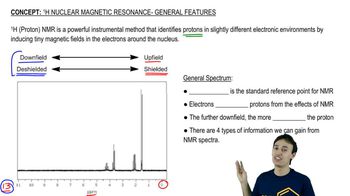
Nuclear Magnetic Resonance (NMR) spectroscopy is a powerful analytical technique used to determine the structure of organic compounds. It provides information about the number of hydrogen atoms in different environments, indicated by peaks in the spectrum. The splitting patterns (singlets, doublets, triplets, etc.) reveal the number of neighboring hydrogen atoms, which helps in deducing the connectivity of atoms within the molecule.
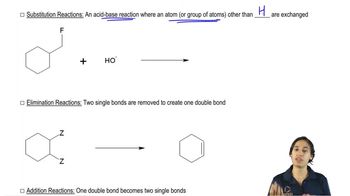
Substitution reactions involve the replacement of one atom or group in a molecule with another. In this case, the treatment of compound A with HBr results in the substitution of a hydroxyl group (-OH) with a bromine atom (-Br). Understanding the mechanism of substitution, whether it is nucleophilic or electrophilic, is crucial for predicting the structure of the resulting compound B.
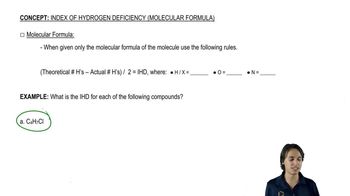
The molecular formula provides essential information about the number and types of atoms in a compound. For compounds A (C5H12O) and B (C5H11Br), analyzing the molecular formula helps in deducing their structures. The presence of functional groups, such as alcohols and alkyl halides, influences the chemical behavior and spectral characteristics, which are critical for identifying the compounds based on their NMR data.