(b) Provide an arrow-pushing mechanism for the reaction. <IMAGE>
Verified step by step guidance
1
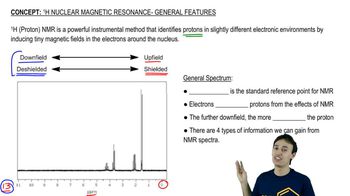
Step 1: Analyze the ¹H NMR spectrum to identify the number of unique hydrogen environments. Count the number of distinct signals, which corresponds to the number of different types of hydrogen atoms in the molecule.
Step 2: Examine the chemical shift of each signal in the ¹H NMR spectrum. Use the chemical shift values to infer the electronic environment of the hydrogens, which can help identify functional groups or structural features.
Step 3: Look at the splitting patterns of each signal in the ¹H NMR spectrum. The splitting pattern (singlet, doublet, triplet, etc.) provides information about the number of neighboring hydrogens, which can help deduce the connectivity of the molecule.
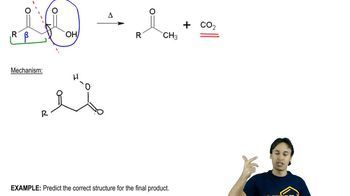
Step 4: For the arrow-pushing mechanism, identify the starting materials and the product of the reaction. Determine the functional groups involved and the type of reaction (e.g., substitution, elimination, addition).
Step 5: Draw the mechanism by showing the movement of electrons with arrows. Start with the nucleophile and electrophile interaction, and illustrate each step of the reaction, ensuring to show the formation and breaking of bonds, and the intermediates formed during the process.
Verified video answer for a similar problem:
This video solution was recommended by our tutors as helpful for the problem above
Video duration:
6m
Play a video:
Was this helpful?
Key Concepts
Here are the essential concepts you must grasp in order to answer the question correctly.
¹H NMR Spectroscopy
¹H NMR spectroscopy is a technique used to determine the structure of organic compounds by analyzing the magnetic properties of hydrogen nuclei. It provides information about the number of hydrogen atoms, their environment, and how they are connected within a molecule. Key features include chemical shifts, multiplicity, and integration, which help identify functional groups and molecular structure.
Arrow-pushing is a method used in organic chemistry to illustrate the movement of electrons during chemical reactions. It involves drawing arrows to show how electron pairs move from one atom or bond to another, helping to visualize the step-by-step transformation of reactants into products. Understanding this concept is crucial for predicting reaction outcomes and mechanisms.
A reaction mechanism is a detailed description of the step-by-step process by which reactants are converted into products in a chemical reaction. It includes the sequence of elementary steps, intermediates, and transition states, providing insight into the kinetics and thermodynamics of the reaction. Understanding mechanisms is essential for designing and optimizing chemical processes.