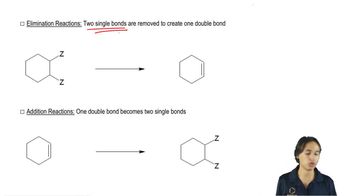
Show the product(s) you expect from dehydration of the following alcohols when they are heated in sulfuric or phosphoric acid. In each case, use a mechanism to show how the products are formed. (c)
Verified step by step guidance
1
Step 1: Recognize that the reaction involves the dehydration of an alcohol. Dehydration typically occurs in the presence of a strong acid, such as sulfuric or phosphoric acid, and heat. The goal is to remove a water molecule and form an alkene.
Step 2: Protonation of the alcohol group occurs first. The hydroxyl group (-OH) is protonated by the acid, converting it into a better leaving group (water). This step increases the reactivity of the alcohol.
Step 3: The protonated alcohol undergoes elimination. The water molecule leaves, forming a carbocation intermediate. Analyze the structure to determine the stability of the carbocation. In this case, the carbocation forms at the carbon attached to the hydroxyl group.
Step 4: Consider carbocation rearrangement if applicable. Check if the carbocation can rearrange to a more stable position (e.g., tertiary carbocation). In this molecule, the carbocation is already stable due to resonance with the double bond in the ring.
Step 5: A base (often the conjugate base of the acid used) removes a proton from a neighboring carbon atom, leading to the formation of a double bond. This step results in the formation of the alkene product. Use Zaitsev's rule to predict the major product, which favors the more substituted alkene.
Verified video answer for a similar problem:
This video solution was recommended by our tutors as helpful for the problem above
Video duration:
3m
Play a video:
Was this helpful?
Key Concepts
Here are the essential concepts you must grasp in order to answer the question correctly.
Dehydration of Alcohols
Dehydration of alcohols involves the elimination of a water molecule from the alcohol, typically in the presence of an acid catalyst like sulfuric or phosphoric acid. This process leads to the formation of alkenes. The reaction can proceed via either an E1 or E2 mechanism, depending on the structure of the alcohol and the reaction conditions.
The E1 mechanism is a two-step process where the alcohol first loses a proton to form a carbocation intermediate, followed by the loss of a water molecule. In contrast, the E2 mechanism is a one-step process where the base abstracts a proton while the leaving group (water) departs simultaneously. The choice between these mechanisms depends on the substrate's structure and the reaction conditions.
Regioselectivity refers to the preference of a chemical reaction to yield one structural isomer over others. In dehydration reactions, the formation of alkenes can lead to different products based on the stability of the resulting double bond. More substituted alkenes are generally favored due to their greater stability, following Zaitsev's rule.