Methyl p-nitrobenzoate has been found to undergo saponification faster than methyl benzoate. (b) Would you expect methyl p-methoxybenzoate to undergo saponification faster or slower than methyl benzoate?
Verified step by step guidance
1
Identify the functional group involved in saponification: Saponification is the base-catalyzed hydrolysis of an ester group, resulting in the formation of a carboxylate salt and an alcohol. Both methyl benzoate and methyl p-methoxybenzoate contain ester groups.
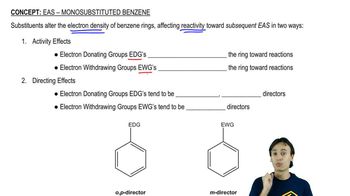
Analyze the electronic effects of the substituent on the aromatic ring: In methyl p-methoxybenzoate, the methoxy group (-OCH₃) is an electron-donating group through resonance and inductive effects. This group donates electron density to the aromatic ring and, consequently, to the ester carbonyl group.
Understand how the electron-donating group affects the reactivity: The electron-donating methoxy group reduces the partial positive charge on the carbonyl carbon of the ester group, making it less electrophilic. This decreases the susceptibility of the carbonyl carbon to nucleophilic attack by hydroxide ions (OH⁻) during saponification.
Compare with methyl benzoate: Methyl benzoate lacks any substituents on the aromatic ring that significantly affect the electron density of the ester group. Therefore, its carbonyl carbon is more electrophilic compared to that of methyl p-methoxybenzoate.
Conclude the relative rate of saponification: Since the carbonyl carbon in methyl p-methoxybenzoate is less electrophilic due to the electron-donating methoxy group, it will undergo saponification slower than methyl benzoate.
Verified video answer for a similar problem:
This video solution was recommended by our tutors as helpful for the problem above
Video duration:
3m
Play a video:
Was this helpful?
Key Concepts
Here are the essential concepts you must grasp in order to answer the question correctly.
Saponification
Saponification is a chemical reaction that involves the hydrolysis of an ester in the presence of a base, typically resulting in the formation of an alcohol and a carboxylate salt. This reaction is crucial in organic chemistry, particularly in the production of soaps from fats and oils. The rate of saponification can be influenced by the structure of the ester, including steric hindrance and electronic effects.
Electronic effects refer to the influence of substituents on the reactivity of a molecule due to their ability to donate or withdraw electron density. In the case of methyl p-methoxybenzoate, the methoxy group is an electron-donating group that can stabilize the transition state during saponification, potentially increasing the reaction rate compared to methyl benzoate, which lacks this stabilizing effect.
Steric hindrance occurs when the spatial arrangement of atoms within a molecule prevents certain reactions from occurring efficiently. In the context of saponification, bulky substituents near the ester bond can impede the approach of the nucleophile (usually hydroxide ion), slowing down the reaction. Understanding the steric effects of substituents is essential for predicting the reactivity of different esters.