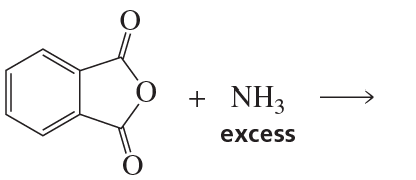
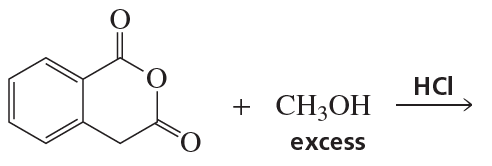
What are the products of the following reactions? i. j.
Verified step by step guidance
1
Step 1: Analyze the reaction in part (i). The starting material is an ester (methyl benzoate), and the reagent is excess ammonia (NH₃). Ammonia reacts with esters in a nucleophilic acyl substitution reaction, where the ammonia attacks the carbonyl carbon of the ester.
Step 2: In part (i), the nucleophilic attack by ammonia leads to the formation of an intermediate tetrahedral structure. The methoxy group (-OCH₃) is displaced, resulting in the formation of a primary amide (benzamide). The excess ammonia ensures complete conversion to the amide.
Step 3: Analyze the reaction in part (ii). The starting material is a cyclic ester (lactone), and the reagent is NaOH followed by acid workup. NaOH hydrolyzes the lactone via nucleophilic attack on the carbonyl carbon, breaking the ring and forming a carboxylate intermediate.
Step 4: In part (ii), after hydrolysis by NaOH, the acid workup protonates the carboxylate group, resulting in the formation of a linear carboxylic acid. The hydroxyl group from the lactone remains intact, forming a hydroxy acid.
Step 5: Summarize the products: (i) The product is benzamide (C₆H₅CONH₂). (ii) The product is a hydroxy acid derived from the lactone, specifically 6-hydroxyhexanoic acid.
Verified video answer for a similar problem:
This video solution was recommended by our tutors as helpful for the problem above
Video duration:
5m
Play a video:
Was this helpful?
Key Concepts
Here are the essential concepts you must grasp in order to answer the question correctly.
Carboxylic Acid Derivatives
Carboxylic acid derivatives, such as esters, amides, and anhydrides, are compounds that can be derived from carboxylic acids. They retain the carboxyl functional group but have different substituents. Understanding their reactivity is crucial, as they can undergo nucleophilic acyl substitution reactions, where a nucleophile replaces the leaving group, leading to the formation of new products.
Nucleophilic acyl substitution is a fundamental reaction in organic chemistry where a nucleophile attacks the electrophilic carbon of a carbonyl group in a carboxylic acid derivative. This reaction typically involves the formation of a tetrahedral intermediate, followed by the elimination of a leaving group. In the context of the question, excess NH3 acts as the nucleophile, leading to the formation of an amide.
Nucleophiles and Electrophiles can react in Substitution Reactions.
Acid-Base Reactions and Workup Procedures
In organic synthesis, acid-base reactions are often used to neutralize reaction mixtures or to facilitate the isolation of products. The term 'acid workup' refers to the process of adding acid to a basic reaction mixture to protonate and precipitate the desired product. In the second reaction, the use of NaOH followed by acid workup indicates that a carboxylic acid is likely formed from the reaction, which can then be isolated.