Propose a mechanism for the hydrolysis of N,N-dimethylacetamide (a) under basic conditions.
Verified step by step guidance
1
Step 1: Identify the functional groups in N,N-dimethylacetamide. The molecule contains an amide functional group, which consists of a carbonyl group (C=O) directly bonded to a nitrogen atom (N). The nitrogen is substituted with two ethyl groups.
Step 2: Understand the reaction conditions. Under basic conditions, hydrolysis involves the attack of hydroxide ions (OH⁻) on the carbonyl carbon of the amide group. This is facilitated by the electrophilic nature of the carbonyl carbon.
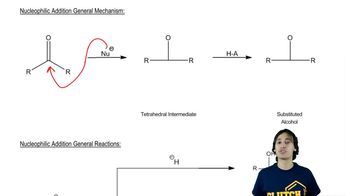
Step 3: Initiate the mechanism. The hydroxide ion (OH⁻) acts as a nucleophile and attacks the electrophilic carbonyl carbon, forming a tetrahedral intermediate. This intermediate has the oxygen atom bearing a negative charge and the nitrogen atom still attached.
Step 4: Break the C-N bond. The tetrahedral intermediate undergoes rearrangement, leading to the cleavage of the bond between the carbonyl carbon and the nitrogen atom. This results in the formation of a carboxylate ion (RCOO⁻) and a free amine (N,N-dimethylethylamine).
Step 5: Finalize the products. Under basic conditions, the carboxylate ion remains deprotonated due to the presence of excess hydroxide ions, and the amine remains neutral. The final products are the carboxylate ion and the amine.
Verified video answer for a similar problem:
This video solution was recommended by our tutors as helpful for the problem above
Video duration:
4m
Play a video:
Was this helpful?
Key Concepts
Here are the essential concepts you must grasp in order to answer the question correctly.
Hydrolysis Mechanism
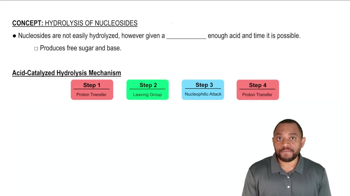
Hydrolysis is a chemical reaction involving the breaking of a bond in a molecule using water. In the case of N,N-dimethylacetamide, the hydrolysis mechanism under basic conditions typically involves nucleophilic attack by hydroxide ions (OH-) on the carbonyl carbon, leading to the formation of a tetrahedral intermediate. This intermediate can then collapse, resulting in the formation of the corresponding carboxylic acid and amine.
Nucleophilic attack is a fundamental concept in organic chemistry where a nucleophile, which is an electron-rich species, attacks an electron-deficient site, usually a carbon atom in a carbonyl group. In the hydrolysis of N,N-dimethylacetamide, the hydroxide ion acts as the nucleophile, attacking the carbonyl carbon, which is susceptible to nucleophilic attack due to the partial positive charge created by the oxygen's electronegativity.
Basic conditions refer to an environment where the pH is greater than 7, typically involving the presence of hydroxide ions (OH-). In the hydrolysis of N,N-dimethylacetamide under basic conditions, the hydroxide ions not only facilitate the nucleophilic attack but also help in deprotonating the amine product, leading to the formation of a more stable product. Understanding the role of the base is crucial for predicting the reaction pathway and products.