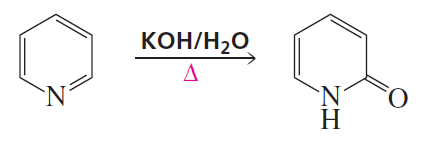
Step 1: Analyze the reactant and product. The reactant is pyridine, a six-membered aromatic ring containing one nitrogen atom. The product is 2-pyridone, which has a ketone group at the 2-position and an NH group replacing the nitrogen atom in the aromatic ring. This indicates a tautomerization reaction involving the addition of water and rearrangement of bonds.
Step 2: Recognize the role of KOH and water. KOH acts as a base, and water provides the necessary environment for the reaction. The heat (Δ) facilitates the reaction by providing energy for bond rearrangement.
Step 3: Initiate the mechanism by protonation of pyridine. The nitrogen atom in pyridine is nucleophilic and can interact with water to form a protonated intermediate. This step disrupts the aromaticity of pyridine.
Step 4: Deprotonation and nucleophilic attack. The hydroxide ion (OH⁻) from KOH can attack the 2-position of the pyridine ring, leading to the formation of an intermediate where the aromaticity is temporarily lost.
Step 5: Rearrange bonds to restore aromaticity and form the ketone group. The intermediate undergoes tautomerization, where a hydrogen atom shifts and the double bonds rearrange to form the final product, 2-pyridone, with the ketone group at the 2-position and the NH group in the ring.
Verified video answer for a similar problem:
This video solution was recommended by our tutors as helpful for the problem above
Video duration:
6m
Play a video:
Was this helpful?
Key Concepts
Here are the essential concepts you must grasp in order to answer the question correctly.
Nucleophilic Aromatic Substitution (NAS)
Nucleophilic Aromatic Substitution is a reaction mechanism where a nucleophile replaces a leaving group on an aromatic ring. This process typically occurs when the aromatic compound has electron-withdrawing groups that stabilize the negative charge developed during the reaction. Understanding this mechanism is crucial for predicting the outcome of reactions involving aromatic compounds, especially when proposing reaction pathways.
The mechanism of nucleophilic aromatic substitution generally involves two main steps: the formation of a Meisenheimer complex, where the nucleophile attacks the aromatic ring, and the subsequent elimination of the leaving group. This two-step process is essential for understanding how the nucleophile interacts with the aromatic system and how the reaction proceeds to completion.
In the reaction shown, KOH acts as a base and water as a solvent, which are critical for facilitating the nucleophilic attack. The base can deprotonate the nucleophile, enhancing its nucleophilicity, while the solvent can stabilize the transition state. Recognizing the roles of the base and solvent helps in understanding the reaction conditions that favor nucleophilic aromatic substitution.