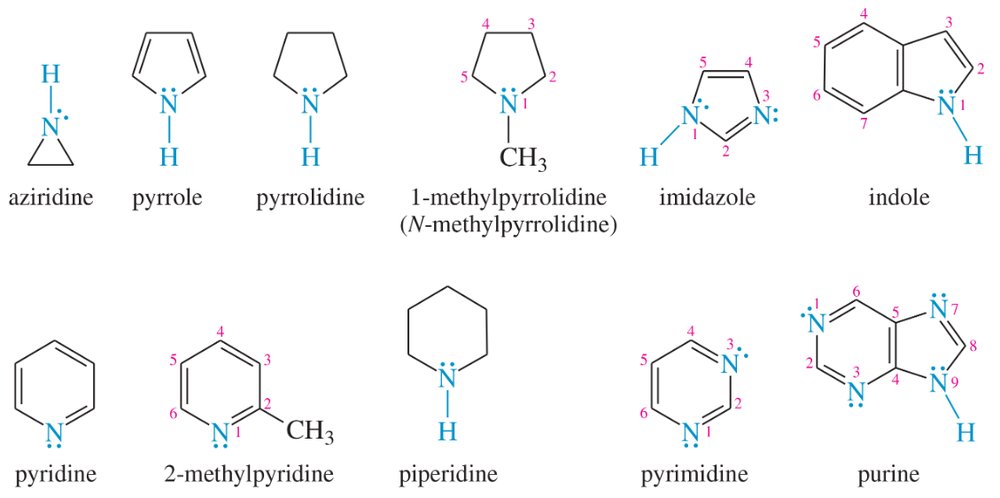
Determine which of the heterocyclic amines just shown are aromatic. Give the reasons for your conclusions.
Verified step by step guidance
1
Step 1: Recall the criteria for aromaticity. A compound is aromatic if it satisfies the following conditions: (a) It is cyclic, (b) It is planar, (c) It has a conjugated π-electron system, and (d) It follows Huckel's rule, which states that the molecule must have (4n + 2) π-electrons, where n is an integer.
Step 2: Analyze each heterocyclic amine structure provided in the first image. Determine whether the molecule is cyclic and planar. For example, aziridine (structure a) is cyclic but lacks conjugation, while pyrrole (structure b) is cyclic, planar, and conjugated.
Step 3: Check the conjugation of π-electrons in each structure. For instance, pyridine (structure g) has alternating double bonds, indicating conjugation, while piperidine (structure i) lacks double bonds and is not conjugated.
Step 4: Apply Huckel's rule to the conjugated systems. Count the π-electrons in the conjugated rings. For example, pyrrole (structure b) has 6 π-electrons (4 from the double bonds and 2 from the lone pair on nitrogen), satisfying Huckel's rule. Similarly, pyridine (structure g) has 6 π-electrons.
Step 5: Conclude which structures are aromatic based on the analysis. For example, pyrrole (b), imidazole (e), pyridine (g), and purine (k) are aromatic because they satisfy all the criteria for aromaticity, while aziridine (a) and piperidine (i) are not aromatic due to lack of conjugation.
Verified video answer for a similar problem:
This video solution was recommended by our tutors as helpful for the problem above
Video duration:
11m
Play a video:
Was this helpful?
Key Concepts
Here are the essential concepts you must grasp in order to answer the question correctly.
Aromaticity
Aromaticity is a property of cyclic compounds that exhibit enhanced stability due to resonance and follow Hückel's rule, which states that a molecule must have (4n + 2) π electrons, where n is a non-negative integer. Aromatic compounds are typically planar, fully conjugated, and have a continuous ring of p-orbitals. This concept is crucial for determining whether the heterocyclic amines in the question are aromatic.
Heterocyclic compounds are cyclic structures that contain at least one atom in the ring that is not carbon, such as nitrogen, oxygen, or sulfur. In the context of the question, the presence of nitrogen atoms in the ring significantly influences the electronic properties and potential aromaticity of the compounds. Understanding the nature of these heteroatoms is essential for analyzing the stability and reactivity of the compounds.
Conjugation refers to the overlap of p-orbitals across adjacent bonds, allowing for the delocalization of π electrons. This delocalization leads to resonance, where multiple structures can represent the same molecule, contributing to its stability. In the context of aromaticity, resonance is a key factor that allows for the distribution of electron density across the ring, which is vital for determining the aromatic nature of the heterocyclic amines presented.