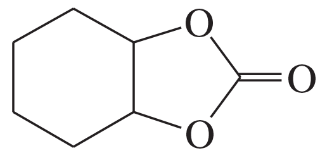
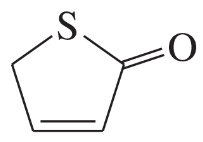
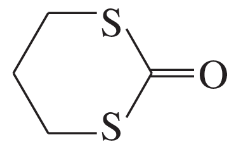
For each heterocyclic compound, (iii) are any of the rings aromatic? Explain. (a) (b) (c)
Verified step by step guidance
1
Step 1: Recall the criteria for aromaticity. A compound is aromatic if it satisfies the following conditions: (a) It is cyclic, (b) It is planar, (c) It has a conjugated π-electron system, and (d) It follows Huckel's rule, which states that the molecule must have (4n + 2) π-electrons, where n is a non-negative integer.
Step 2: Analyze compound (a). The structure contains a fused ring system with one benzene ring and a five-membered ring containing two oxygen atoms. The benzene ring is aromatic because it is cyclic, planar, conjugated, and has 6 π-electrons (4n + 2, where n = 1). The five-membered ring is not aromatic because it does not have a conjugated π-electron system.
Step 3: Analyze compound (b). The structure is a six-membered ring containing sulfur and an oxygen atom. The ring is conjugated and planar, and it has 6 π-electrons (4n + 2, where n = 1). Therefore, this ring is aromatic.
Step 4: Analyze compound (c). The structure is a five-membered ring containing nitrogen and an oxygen atom. The ring is not conjugated because the lone pair on nitrogen is not part of the π-system, and it does not satisfy Huckel's rule. Therefore, this ring is not aromatic.
Step 5: Summarize the findings. Compound (a) has an aromatic benzene ring, compound (b) is aromatic, and compound (c) is not aromatic.
Verified video answer for a similar problem:
This video solution was recommended by our tutors as helpful for the problem above
Video duration:
3m
Play a video:
Was this helpful?
Key Concepts
Here are the essential concepts you must grasp in order to answer the question correctly.
Aromaticity
Aromaticity is a property of cyclic compounds that exhibit enhanced stability due to the delocalization of π electrons across the ring. For a compound to be aromatic, it must follow Hückel's rule, which states that it should have a planar structure and contain a total of 4n + 2 π electrons, where n is a non-negative integer. This delocalization leads to a lower energy state and unique chemical reactivity.
Heterocyclic compounds are cyclic structures that contain at least one atom in the ring that is not carbon, such as nitrogen, oxygen, or sulfur. These compounds can exhibit diverse chemical properties and biological activities, making them significant in pharmaceuticals and organic chemistry. The presence of heteroatoms can influence the aromaticity and stability of the compound.
To determine if a heterocyclic compound is aromatic, one must assess its structure for planarity, cyclic nature, and the presence of 4n + 2 π electrons. Additionally, the compound should not have any sp3 hybridized atoms in the ring, as these do not contribute to π electron delocalization. Evaluating these criteria helps in identifying whether the compound can be classified as aromatic.