An alkyl halide reacts with an alkoxide ion to form a compound whose 1H NMR spectrum is shown here. Identify the alkyl halide and the alkoxide ion. (Hint: See Section 9.15.) <IMAGE>
Verified step by step guidance
1
Step 1: Analyze the 1H NMR spectrum provided. The spectrum shows three distinct signals: a singlet at approximately 1.2 ppm corresponding to 9 hydrogens, a doublet at approximately 1.0 ppm corresponding to 6 hydrogens, and a quartet at approximately 3.5 ppm corresponding to 2 hydrogens. Additionally, there is a small singlet at approximately 2.2 ppm corresponding to 1 hydrogen.
Step 2: Interpret the signal at 1.2 ppm (9 H, singlet). This is characteristic of a tert-butyl group ((CH3)3C), where the three methyl groups are equivalent and produce a singlet due to the lack of neighboring hydrogens.
Step 3: Interpret the signal at 1.0 ppm (6 H, doublet). This is indicative of two equivalent methyl groups adjacent to a single hydrogen atom, which causes splitting into a doublet. This suggests the presence of an ethyl group (-CH2CH3).
Step 4: Interpret the signal at 3.5 ppm (2 H, quartet). This is characteristic of a methylene group (-CH2-) adjacent to a methyl group (-CH3), which causes splitting into a quartet. This further supports the presence of an ethyl group.
Step 5: Combine the information to deduce the reactants. The tert-butyl group likely comes from the alkoxide ion (tert-butoxide, (CH3)3CO-), and the ethyl group likely comes from the alkyl halide (ethyl bromide, CH3CH2Br). The reaction between tert-butoxide and ethyl bromide forms tert-butyl ethyl ether ((CH3)3COCH2CH3), consistent with the NMR spectrum.
Verified video answer for a similar problem:
This video solution was recommended by our tutors as helpful for the problem above
Video duration:
7m
Play a video:
Was this helpful?
Key Concepts
Here are the essential concepts you must grasp in order to answer the question correctly.
Alkyl Halides
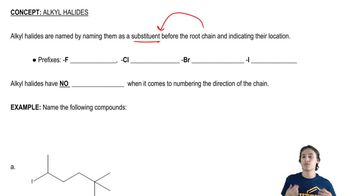
Alkyl halides are organic compounds containing a carbon atom bonded to a halogen atom (F, Cl, Br, I). They are important in organic synthesis and can undergo nucleophilic substitution reactions. Understanding the structure and reactivity of alkyl halides is crucial for predicting the products of reactions, such as those involving alkoxide ions.
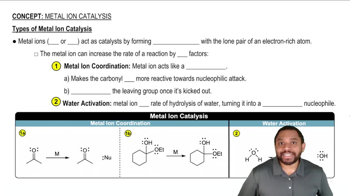
Alkoxide ions are negatively charged species formed by deprotonation of alcohols. They are strong nucleophiles and are commonly used in organic reactions, particularly in the formation of ethers and in nucleophilic substitutions. Recognizing the structure and reactivity of alkoxide ions is essential for determining the outcome of reactions with alkyl halides.
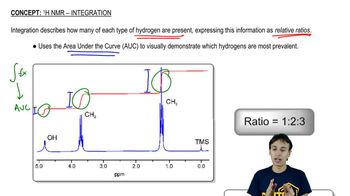
1H NMR (Proton Nuclear Magnetic Resonance) spectroscopy is a powerful analytical technique used to determine the structure of organic compounds. It provides information about the number of hydrogen atoms in different environments, as indicated by chemical shifts and integration of peaks. Analyzing the NMR spectrum helps identify the alkyl halide and alkoxide ion involved in the reaction by correlating peak patterns with molecular structures.