
The following 1H NMR spectra are for four compounds, each with molecular formula of C6H12O2. Identify the compounds. c. <IMAGE>
Verified step by step guidance
1
Analyze the molecular formula C6H12O2. This indicates the presence of 6 carbons, 12 hydrogens, and 2 oxygens. The degree of unsaturation is calculated as follows: (2C + 2 - H)/2 = (2(6) + 2 - 12)/2 = 1. This suggests one double bond or ring in the structure.
Examine the 1H NMR spectrum. The peak at approximately 8 ppm corresponds to a deshielded proton, likely from an aldehyde group (-CHO). Aldehyde protons typically appear in the range of 9-10 ppm, but this shift is slightly lower, possibly due to electronic effects.
The peak at approximately 4 ppm integrates to 2 hydrogens. This is indicative of a -CH2 group adjacent to an electronegative atom, such as oxygen. This suggests the presence of an ester or ether functional group.
The peak at approximately 2 ppm integrates to 1 hydrogen. This is likely a -CH group adjacent to a carbonyl group, as protons in this environment typically appear in the range of 2-3 ppm.
The peak at approximately 1 ppm integrates to 6 hydrogens. This is characteristic of two equivalent methyl groups (-CH3) in a symmetrical environment, such as adjacent to the same carbon atom or functional group.
Verified video answer for a similar problem:
This video solution was recommended by our tutors as helpful for the problem above
Video duration:
7m
Play a video:
Was this helpful?
Key Concepts
Here are the essential concepts you must grasp in order to answer the question correctly.
1H NMR Spectroscopy
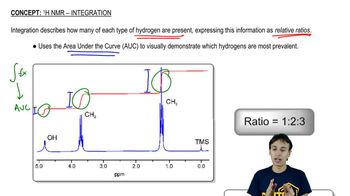
Proton Nuclear Magnetic Resonance (1H NMR) spectroscopy is a powerful analytical technique used to determine the structure of organic compounds. It provides information about the number of hydrogen atoms in different environments within a molecule, indicated by peaks at specific chemical shift values (PPM). The area under each peak correlates with the number of protons contributing to that signal, allowing for the identification of functional groups and molecular structure.
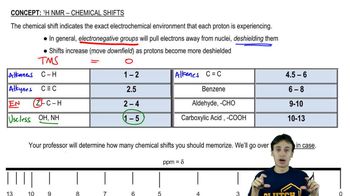
Chemical shifts in 1H NMR are measured in parts per million (PPM) and reflect the electronic environment surrounding hydrogen atoms. Different functional groups and molecular structures cause protons to resonate at different frequencies, resulting in distinct chemical shifts. For example, protons attached to electronegative atoms like oxygen appear downfield (higher PPM), while those in alkyl groups appear upfield (lower PPM). Understanding these shifts is crucial for interpreting NMR spectra.
Integration in 1H NMR refers to the area under the peaks, which indicates the relative number of protons contributing to each signal. Multiplicity, determined by the splitting of peaks, provides insight into the number of neighboring protons (n+1 rule). For instance, a singlet indicates no neighboring protons, while a doublet suggests one neighboring proton. Together, integration and multiplicity help deduce the connectivity and arrangement of atoms in the molecule.