Sketch the following spectra that would be obtained for 2-chloroethanol: a. The 1H NMR spectrum for an anhydrous sample of the alcohol.
Verified step by step guidance
1
Identify the structure of 2-chloroethanol (ClCH2CH2OH) and determine the number of unique hydrogen environments. There are three distinct environments: (1) the hydrogens on the CH2 group attached to the chlorine, (2) the hydrogens on the CH2 group attached to the hydroxyl group, and (3) the hydroxyl (OH) hydrogen.
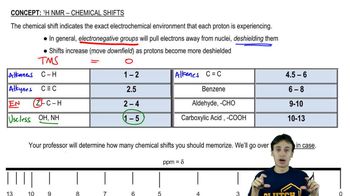
Predict the chemical shifts for each hydrogen environment: (1) The CH2 group attached to the electronegative chlorine will appear downfield (higher ppm) due to deshielding, (2) the CH2 group attached to the hydroxyl group will also be deshielded but less so than the first group, and (3) the OH hydrogen will appear as a broad singlet, typically in the range of 1-5 ppm, depending on hydrogen bonding.
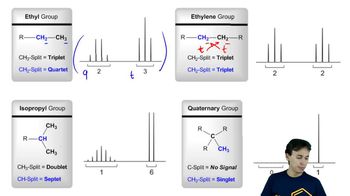
Determine the splitting patterns for each group based on the n+1 rule: (1) The CH2 group attached to chlorine will be split into a triplet by the adjacent CH2 group (n=2), (2) the CH2 group attached to the hydroxyl group will be split into a quartet by the adjacent CH2 group (n=3), and (3) the OH hydrogen will typically appear as a singlet because it does not couple strongly with neighboring hydrogens.
Estimate the relative integration of the peaks: (1) The CH2 group attached to chlorine will integrate to 2 hydrogens, (2) the CH2 group attached to the hydroxyl group will also integrate to 2 hydrogens, and (3) the OH hydrogen will integrate to 1 hydrogen.
Sketch the spectrum: Place the peaks at their approximate chemical shifts, with the appropriate splitting patterns and relative integrations. Ensure the triplet for the CH2 group attached to chlorine, the quartet for the CH2 group attached to the hydroxyl group, and the broad singlet for the OH hydrogen are clearly represented.
Verified video answer for a similar problem:
This video solution was recommended by our tutors as helpful for the problem above
Video duration:
6m
Play a video:
Was this helpful?
Key Concepts
Here are the essential concepts you must grasp in order to answer the question correctly.
Nuclear Magnetic Resonance (NMR) Spectroscopy
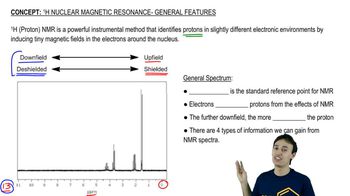
NMR spectroscopy is a powerful analytical technique used to determine the structure of organic compounds. It relies on the magnetic properties of certain nuclei, primarily hydrogen (1H), to provide information about the number of hydrogen atoms, their environment, and connectivity in a molecule. The resulting spectrum displays peaks corresponding to different hydrogen environments, allowing chemists to infer structural details.
Chemical shifts in NMR spectroscopy refer to the variation in resonance frequency of nuclei due to their electronic environment. Measured in parts per million (ppm), these shifts help identify the type of hydrogen atoms present in a molecule. For 2-chloroethanol, the chemical shifts will indicate the presence of hydrogen atoms on the carbon adjacent to the hydroxyl group and those on the carbon bonded to chlorine, reflecting their differing electronic environments.
Integration in NMR refers to the area under the peaks, which correlates to the number of hydrogen atoms contributing to that signal. Splitting patterns arise from the interaction of neighboring hydrogen atoms, described by the n+1 rule, where n is the number of adjacent hydrogens. In the case of 2-chloroethanol, the integration and splitting will reveal the number of hydrogen atoms on each carbon and their relationships, providing insight into the molecule's structure.