
Show how you would accomplish the following synthetic transformations. You may use any necessary reagents. (a) N-ethylbenzamide → benzylethylamine (b) ethyl benzoate → N-ethylbenzamide
Verified step by step guidance
1
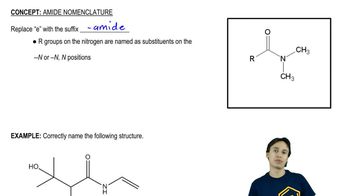
Step 1 (a): To convert N-ethylbenzamide to benzylethylamine, first identify the functional group transformation. This involves reducing the amide group (-CONH-) to an amine (-NH-). Use a reducing agent such as lithium aluminum hydride (LiAlH4) in an appropriate solvent like ether to achieve this reduction.
Step 2 (a): After the reduction, the product will be benzylethylamine, where the carbonyl group is removed, leaving a secondary amine attached to the benzyl group and ethyl group.
Step 1 (b): To convert ethyl benzoate to N-ethylbenzamide, first hydrolyze the ester group (-COOEt) to a carboxylic acid (-COOH). This can be done using aqueous acid (HCl) or base (NaOH) under reflux conditions.
Step 2 (b): Once the carboxylic acid is formed, react it with ethylamine (CH3CH2NH2) in the presence of a coupling agent such as dicyclohexylcarbodiimide (DCC) or use an acid chloride intermediate (benzoyl chloride) to form the amide bond.
Step 3 (b): The final product will be N-ethylbenzamide, where the ethyl group is attached to the nitrogen of the amide functional group.
Verified video answer for a similar problem:
This video solution was recommended by our tutors as helpful for the problem above
Video duration:
8m
Play a video:
Was this helpful?
Key Concepts
Here are the essential concepts you must grasp in order to answer the question correctly.
Amide Hydrolysis
Amide hydrolysis is a reaction where an amide is converted into a carboxylic acid and an amine through the addition of water. This reaction can be catalyzed by either acid or base. In the context of the transformation from N-ethylbenzamide to benzylethylamine, hydrolysis can help in breaking down the amide bond, allowing for the formation of the desired amine.
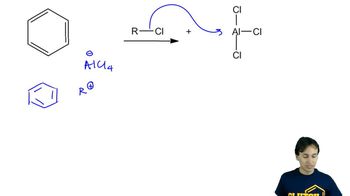
Friedel-Crafts alkylation is a method used to attach alkyl groups to aromatic rings using alkyl halides and a Lewis acid catalyst. This reaction is crucial for synthesizing benzylethylamine from N-ethylbenzamide, as it allows for the introduction of the ethyl group onto the benzene ring, facilitating the formation of the desired product.
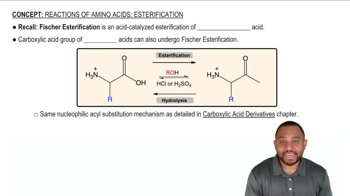
Esterification is the process of forming an ester from a carboxylic acid and an alcohol, while transesterification involves exchanging the alkoxy group of an ester with another alcohol. In the transformation from ethyl benzoate to N-ethylbenzamide, the reaction involves converting the ester into an amide, typically through the reaction with an amine, which is essential for achieving the desired synthetic pathway.