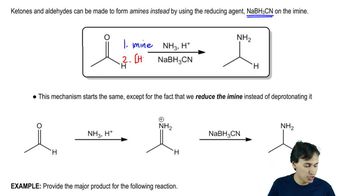
Sodium triacetoxyborohydride, NaBH(OAc)3, is a mild reducing agent that reduces aldehydes much more quickly than ketones. It can be used to reduce aldehydes in the presence of ketones, such as in the following reaction: (b) Propose a mechanism for the reduction of an aldehyde by sodium triacetoxyborohydride.
Verified step by step guidance
1
Step 1: Recognize the role of sodium triacetoxyborohydride (NaBH(OAc)3) as a mild reducing agent. It selectively reduces aldehydes to alcohols in the presence of ketones due to its preference for the more reactive carbonyl group of aldehydes.
Step 2: Identify the aldehyde functional group in the reactant molecule. The aldehyde group is characterized by a carbonyl group (C=O) bonded to a hydrogen atom. In the provided reaction, the aldehyde group is located at the terminal position of the molecule.
Step 3: Propose the mechanism for the reduction. The hydride ion (H⁻) from NaBH(OAc)3 attacks the electrophilic carbon of the aldehyde's carbonyl group. This nucleophilic attack leads to the formation of a tetrahedral intermediate.
Step 4: The tetrahedral intermediate undergoes protonation, facilitated by the acetic acid (CH3COOH) present in the reaction. This step converts the intermediate into the final alcohol product, where the aldehyde is reduced to a primary alcohol.
Step 5: Note that the ketone group remains unaffected during the reaction because sodium triacetoxyborohydride is selective for aldehydes. The ketone group retains its carbonyl structure in the product.
Verified video answer for a similar problem:
This video solution was recommended by our tutors as helpful for the problem above
Video duration:
4m
Play a video:
Was this helpful?
Key Concepts
Here are the essential concepts you must grasp in order to answer the question correctly.
Reduction Reactions
Reduction reactions involve the gain of electrons or the decrease in oxidation state by a molecule. In organic chemistry, this often refers to the conversion of carbonyl compounds, such as aldehydes and ketones, into alcohols. Sodium triacetoxyborohydride (NaBH(OAc)3) is a mild reducing agent that selectively reduces aldehydes more rapidly than ketones, making it useful in synthetic organic chemistry.
The mechanism of aldehyde reduction typically involves the nucleophilic attack of a hydride ion (H-) on the carbonyl carbon, leading to the formation of an alkoxide intermediate. This intermediate can then be protonated to yield the corresponding alcohol. Understanding this mechanism is crucial for predicting the outcome of reactions involving aldehydes and reducing agents like sodium triacetoxyborohydride.
Selectivity in reductions refers to the ability of a reducing agent to preferentially react with one functional group over another. In the case of sodium triacetoxyborohydride, its selectivity allows it to reduce aldehydes in the presence of ketones, which is significant in complex organic syntheses. This selectivity is influenced by the sterics and electronics of the substrates involved.