Predict the products of the following reactions: (i)
Verified step by step guidance
1
Analyze the starting material: The molecule is a substituted cyclohexane with a dimethylamino group (NMe2), a hydrogen (H), and a deuterium (D) attached to the same carbon atom. The stereochemistry of H and D is indicated as wedge and dash, respectively.
Identify the reaction type: The product contains a double bond, suggesting that the reaction involves elimination. Specifically, this appears to be an E2 elimination reaction, where a base removes a proton, leading to the formation of a double bond.
Determine the stereochemical requirements for E2 elimination: In E2 reactions, the proton to be removed and the leaving group must be anti-periplanar (i.e., opposite in the same plane). In this case, the hydrogen (H) and the dimethylamino group (NMe2) are anti-periplanar, making them suitable for elimination.
Predict the product: The elimination of H and NMe2 will result in the formation of a double bond between the carbon atoms where the elimination occurs. The deuterium (D) remains attached to the carbon atom, as it is not involved in the elimination process.
Verify the regioselectivity and stereochemistry: The product is a substituted cyclohexene with the double bond formed in the most stable position, consistent with the anti-periplanar geometry and the stereochemical constraints of the reaction.
Verified video answer for a similar problem:
This video solution was recommended by our tutors as helpful for the problem above
Video duration:
1m
Play a video:
0 Comments
Key Concepts
Here are the essential concepts you must grasp in order to answer the question correctly.
Nucleophilic Substitution
Nucleophilic substitution is a fundamental reaction in organic chemistry where a nucleophile replaces a leaving group in a molecule. In this case, the dimethylamine (NMe2) acts as a nucleophile, attacking the carbon atom bonded to the deuterium (D) and hydrogen (H) in the cyclohexane derivative. Understanding this mechanism is crucial for predicting the products of the reaction.
Nucleophiles and Electrophiles can react in Substitution Reactions.
Stereochemistry
Stereochemistry refers to the spatial arrangement of atoms in molecules and how this affects their chemical behavior. In the given reaction, the stereochemistry of the cyclohexane derivative is important, as the orientation of the substituents (D and NMe2) can influence the outcome of the reaction. Recognizing the stereochemical implications helps in predicting the correct product formation.
Elimination reactions involve the removal of atoms or groups from a molecule, resulting in the formation of a double bond or ring structure. In this scenario, the reaction may lead to the elimination of deuterium and the formation of a double bond in the cyclohexane derivative. Understanding elimination mechanisms is essential for predicting the final product of the reaction.


 1:57 minutes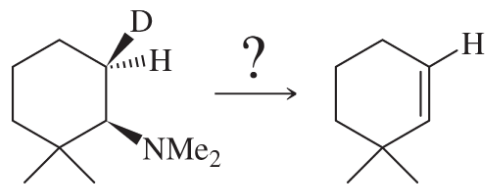
 Verified step by step guidance

 01:47
01:47