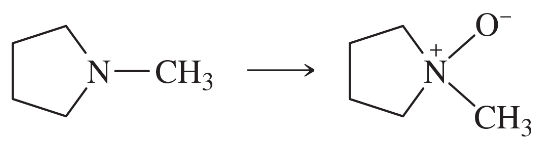
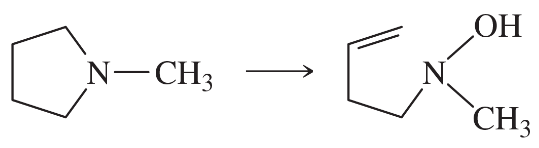
Using any necessary reagents, show how you would accomplish the following syntheses. (e) (f)
Verified step by step guidance
1
Step 1: For reaction (a), identify the starting material as an ethylamine derivative of cyclohexane and the product as a quaternary ammonium salt. This suggests the reaction involves alkylation of the amine group.
Step 2: To achieve the transformation in (a), use an alkyl halide such as ethyl bromide (CH3CH2Br) as the reagent. The nitrogen atom in the amine group will act as a nucleophile and attack the alkyl halide, forming the quaternary ammonium salt.
Step 3: For reaction (b), identify the starting material as the same ethylamine derivative of cyclohexane and the product as a compound with an extended carbon chain containing a hydroxyl group and a double bond.
Step 4: To accomplish the transformation in (b), use a sequence of reactions. First, perform an alkylation reaction to introduce the extended carbon chain using an alkyl halide such as 1-bromohexane. Then, oxidize the terminal carbon to introduce the hydroxyl group using an oxidizing agent like PCC (Pyridinium Chlorochromate).
Step 5: Finally, introduce the double bond in the extended chain by performing an elimination reaction using a base such as NaOH or KOH. This will remove a hydrogen atom and a leaving group, forming the double bond in the desired position.
Verified video answer for a similar problem:
This video solution was recommended by our tutors as helpful for the problem above
Video duration:
6m
Play a video:
Was this helpful?
Key Concepts
Here are the essential concepts you must grasp in order to answer the question correctly.
Cope Elimination
Cope elimination is a reaction mechanism involving the removal of a leaving group and a hydrogen atom from adjacent carbon atoms, resulting in the formation of an alkene. This process typically occurs in the presence of a base and is characterized by a concerted mechanism, where bond breaking and forming happen simultaneously. Understanding this mechanism is crucial for predicting the products of reactions involving amines and cyclic compounds.
Amines are organic compounds derived from ammonia by replacing one or more hydrogen atoms with alkyl or aryl groups. Their reactivity is influenced by the presence of the nitrogen atom, which can act as a nucleophile or a base. In synthetic organic chemistry, amines can undergo various transformations, including alkylation and acylation, making them versatile intermediates in the synthesis of more complex molecules.
Understanding reaction mechanisms is essential in organic chemistry as it provides insight into how reactants transform into products. Mechanisms detail the step-by-step process of a reaction, including the formation and breaking of bonds, the role of catalysts, and the energy changes involved. This knowledge allows chemists to predict reaction outcomes and design synthetic pathways effectively, particularly in complex reactions like those involving amines.