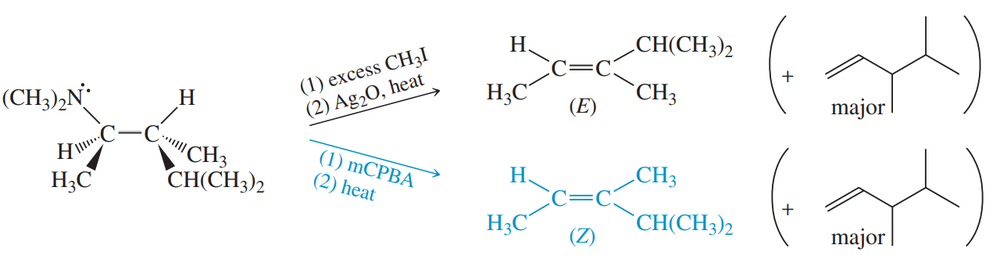
When the (R,R) isomer of the amine shown is treated with an excess of methyl iodide, then silver oxide, then heated, the major product is the Hofmann product. (b) Some Zaitsev product is also formed. It has the (E) configuration. When the same amine is treated with mCPBA and heated, the Zaitsev product has the (Z) configuration. Use stereochemical drawings of the transition states to explain these observations.
Verified step by step guidance
1
Step 1: Analyze the reaction with methyl iodide and silver oxide. The amine undergoes exhaustive methylation with excess methyl iodide, converting the nitrogen into a quaternary ammonium salt. This salt is then treated with silver oxide and heated, leading to the Hofmann elimination reaction. The Hofmann elimination favors the formation of the less substituted alkene (Hofmann product) due to steric hindrance in the transition state.
Step 2: Examine the stereochemical outcome of the Hofmann elimination. The transition state involves anti-periplanar geometry, where the β-hydrogen and the leaving group (quaternary ammonium group) are aligned in opposite planes. This geometry leads to the formation of the (E) configuration for the Zaitsev product, which is the more substituted alkene formed as a minor product.
Step 3: Analyze the reaction with mCPBA and heat. mCPBA (meta-chloroperoxybenzoic acid) oxidizes the amine to form an amine oxide. Upon heating, the amine oxide undergoes Cope elimination, which favors the formation of the more substituted alkene (Zaitsev product). The Cope elimination occurs via a syn-elimination mechanism, where the β-hydrogen and the leaving group are aligned in the same plane.
Step 4: Examine the stereochemical outcome of the Cope elimination. The syn-elimination mechanism leads to the (Z) configuration for the Zaitsev product due to the stereochemical arrangement of the substituents in the transition state. This contrasts with the (E) configuration observed in the Hofmann elimination.
Step 5: Compare the two elimination mechanisms. The Hofmann elimination (anti-periplanar geometry) and the Cope elimination (syn-elimination geometry) result in different stereochemical outcomes for the Zaitsev product. The Hofmann elimination produces the (E) configuration, while the Cope elimination produces the (Z) configuration, highlighting the influence of the elimination mechanism on stereochemistry.
Verified video answer for a similar problem:
This video solution was recommended by our tutors as helpful for the problem above
Video duration:
4m
Play a video:
Was this helpful?
Key Concepts
Here are the essential concepts you must grasp in order to answer the question correctly.
Hofmann Rearrangement
The Hofmann rearrangement is a chemical reaction that converts primary amides into primary amines with the loss of one carbon atom. This reaction involves the formation of an isocyanate intermediate, which can then hydrolyze to yield the amine. Understanding this mechanism is crucial for predicting the products when the (R,R) isomer of the amine is treated with methyl iodide and silver oxide.
Zaitsev's rule states that in elimination reactions, the more substituted alkene is typically the major product. This principle helps explain the formation of the Zaitsev product in the reaction, as the (E) configuration indicates a more stable, substituted alkene. Recognizing this rule is essential for understanding the stereochemical outcomes of the reactions described.
Stereochemistry involves the study of the spatial arrangement of atoms in molecules and how this affects their chemical behavior. The (E) and (Z) configurations refer to the relative positioning of substituents around a double bond, influencing the stability and reactivity of the resulting alkenes. Analyzing the transition states with stereochemical drawings is vital for elucidating the differences in product formation under varying reaction conditions.