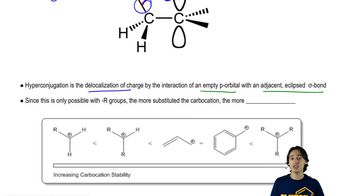
Step 1: Analyze the stability of carbocations based on their degree of substitution. Carbocations are classified as primary, secondary, or tertiary depending on the number of alkyl groups attached to the positively charged carbon. More substituted carbocations are generally more stable due to hyperconjugation and inductive effects.
Step 2: Compare the two species in the pair. The first species, CH3C+HCH2CH3, is a secondary carbocation because the positively charged carbon is attached to two alkyl groups (CH3 and CH2CH3). The second species, CH3CH2CH2C+H2, is a primary carbocation because the positively charged carbon is attached to only one alkyl group (CH2CH2CH3).
Step 3: Consider hyperconjugation. Secondary carbocations benefit from more hyperconjugation interactions compared to primary carbocations, as they have more adjacent C-H bonds that can donate electron density to stabilize the positive charge.
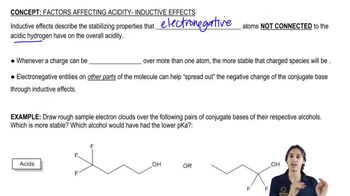
Step 4: Evaluate inductive effects. Alkyl groups are electron-donating through inductive effects, which help stabilize the positive charge on the carbocation. Secondary carbocations have more alkyl groups contributing to this stabilization compared to primary carbocations.
Step 5: Conclude that CH3C+HCH2CH3 (secondary carbocation) is more stable than CH3CH2CH2C+H2 (primary carbocation) due to the combined effects of hyperconjugation and inductive stabilization.
Verified video answer for a similar problem:
This video solution was recommended by our tutors as helpful for the problem above
Video duration:
6m
Play a video:
Was this helpful?
Key Concepts
Here are the essential concepts you must grasp in order to answer the question correctly.
Carbocation Stability
Carbocations are positively charged carbon species that are classified based on their degree of substitution: primary, secondary, and tertiary. Tertiary carbocations are the most stable due to hyperconjugation and the inductive effect from surrounding alkyl groups, which help to disperse the positive charge. Understanding the stability of carbocations is crucial for predicting the reactivity and outcomes of organic reactions.
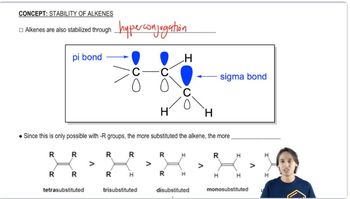
Hyperconjugation is a stabilizing interaction that occurs when the electrons in a sigma bond (C-H or C-C) interact with an adjacent empty p-orbital or a positively charged carbon. This effect allows for the delocalization of charge, which stabilizes carbocations. The more alkyl groups attached to the positively charged carbon, the greater the hyperconjugation, leading to increased stability.
The inductive effect refers to the electron-donating or withdrawing effects of substituents through sigma bonds. Alkyl groups are electron-donating and can stabilize positive charges on carbocations by pushing electron density towards the positively charged carbon. This effect is significant in determining the relative stability of carbocations, as more electron-donating groups lead to greater stability.