Show how crossed Claisen condensations could be used to prepare the following esters. (b)
Verified step by step guidance
1
Step 1: Identify the ester product and analyze its structure. The given ester contains two ester functional groups (-COOCH3) and a phenyl group (Ph) attached to a central carbon. This suggests that the product could be formed via a crossed Claisen condensation between two different esters.
Step 2: Determine the two esters required for the crossed Claisen condensation. One ester should provide the phenyl group (Ph) and the alpha-hydrogen for enolate formation, while the other ester should provide the second ester group. For this product, methyl benzoate (PhCOOCH3) and dimethyl malonate (CH2(CO2CH3)2) are suitable reactants.
Step 3: Describe the mechanism of the crossed Claisen condensation. In the presence of a strong base (e.g., sodium ethoxide, NaOEt), the alpha-hydrogen of dimethyl malonate is deprotonated to form an enolate ion. This enolate then attacks the carbonyl carbon of methyl benzoate, leading to the formation of a new carbon-carbon bond.
Step 4: Explain the intermediate and subsequent steps. After the nucleophilic attack, a tetrahedral intermediate is formed, which collapses to expel the methoxide ion (CH3O−). This results in the formation of a β-keto ester intermediate.
Step 5: Highlight the final product formation. The β-keto ester intermediate undergoes protonation to yield the final ester product shown in the image. Ensure that the reaction conditions (base, solvent, and temperature) are carefully controlled to favor the crossed Claisen condensation and minimize side reactions.
Verified video answer for a similar problem:
This video solution was recommended by our tutors as helpful for the problem above
Video duration:
1m
Play a video:
0 Comments
Key Concepts
Here are the essential concepts you must grasp in order to answer the question correctly.
Claisen Condensation
Claisen condensation is a reaction between two esters or an ester and a carbonyl compound in the presence of a strong base, leading to the formation of a β-keto ester or a β-diketone. This reaction is crucial for forming carbon-carbon bonds and is widely used in organic synthesis to create complex molecules.
Crossed Claisen condensation involves the reaction of two different esters or an ester with a carbonyl compound, allowing for greater diversity in the products formed. This method is particularly useful when one of the reactants has no alpha-hydrogens, preventing self-condensation and enabling the formation of specific products, such as the esters shown in the question.
Esters are reactive compounds in organic chemistry, particularly due to the presence of the carbonyl group, which is susceptible to nucleophilic attack. Understanding the reactivity of esters, including their ability to undergo Claisen condensation, is essential for predicting the outcomes of reactions and designing synthetic pathways for desired compounds.


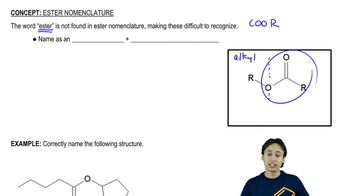
 1:35 minutes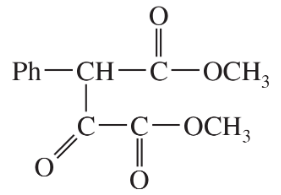
 Verified step by step guidance
 08:28
08:28