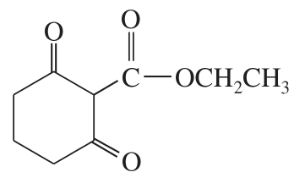
Show how Claisen condensations could be used to make the following compounds. (d)
Verified step by step guidance
1
Step 1: Identify the target molecule and recognize that it contains a β-keto ester functional group, which is characteristic of a Claisen condensation product. The molecule has a cyclic ketone and an ester group connected to the same carbon.
Step 2: Determine the starting materials for the Claisen condensation. A Claisen condensation typically involves two esters or one ester and one ketone. In this case, the cyclic ketone (cyclohexanone) and ethyl acetate (CH3COOCH2CH3) are suitable starting materials.
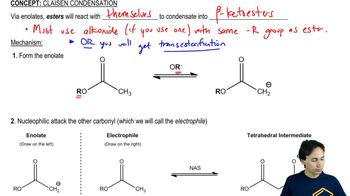
Step 3: Outline the reaction mechanism. The Claisen condensation begins with the deprotonation of the α-hydrogen of ethyl acetate by a strong base, such as sodium ethoxide (NaOEt), to form an enolate ion. This enolate ion then attacks the carbonyl carbon of cyclohexanone, forming a new carbon-carbon bond.
Step 4: Describe the intermediate formed. After the nucleophilic attack, a tetrahedral intermediate is formed, which subsequently collapses to expel the ethoxide ion (CH3CH2O−), resulting in the β-keto ester product.
Step 5: Highlight the final step. The reaction is typically followed by an acidic workup to neutralize the base and stabilize the product. The final compound is the β-keto ester shown in the image, formed through the Claisen condensation of cyclohexanone and ethyl acetate.
Verified video answer for a similar problem:
This video solution was recommended by our tutors as helpful for the problem above
Video duration:
6m
Play a video:
Was this helpful?
Key Concepts
Here are the essential concepts you must grasp in order to answer the question correctly.
Claisen Condensation
Claisen condensation is a reaction between two esters or an ester and a carbonyl compound in the presence of a strong base, leading to the formation of a β-keto ester or a β-dicarbonyl compound. This reaction is crucial for forming carbon-carbon bonds and is widely used in organic synthesis to create complex molecules.
Carbonyl compounds, which include aldehydes and ketones, contain a carbon atom double-bonded to an oxygen atom. Their reactivity is significant in organic chemistry, particularly in nucleophilic addition reactions and condensation reactions, such as the Claisen condensation, where they can act as electrophiles.
Functional groups are specific groups of atoms within molecules that are responsible for the characteristic chemical reactions of those molecules. In the context of the compound shown, the presence of carbonyl groups (C=O) and an ethoxy group (–OCH2CH3) indicates potential sites for reactivity and transformation, which are essential for understanding how to synthesize the compound through Claisen condensation.