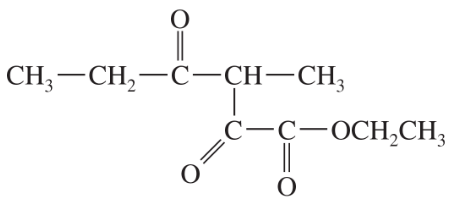
Show how Claisen condensations could be used to make the following compounds. (b)
Verified step by step guidance
1
Step 1: Identify the target molecule and recognize that it is a β-keto ester, which is a common product of a Claisen condensation reaction. The structure contains two carbonyl groups separated by a single carbon atom, indicating the presence of a β-keto functionality.
Step 2: Break down the target molecule into two potential starting esters. In a Claisen condensation, one ester acts as the nucleophile and the other as the electrophile. Here, the ethyl ester group (CH3CH2OCO-) and the ketone group (CH3CH2CO-) suggest the starting materials could be ethyl acetate and ethyl propanoate.
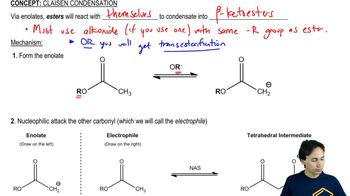
Step 3: Write the mechanism for the Claisen condensation. The reaction begins with the deprotonation of the α-hydrogen of one ester (e.g., ethyl acetate) by a strong base, such as sodium ethoxide (NaOCH2CH3), to form an enolate ion. This enolate ion then attacks the carbonyl carbon of the second ester (e.g., ethyl propanoate), forming a tetrahedral intermediate.
Step 4: Describe the collapse of the tetrahedral intermediate. The intermediate eliminates the ethoxide ion (CH3CH2O-) to form the β-keto ester product. This step is driven by the stability of the conjugated β-keto system.
Step 5: Highlight the final step of the reaction. After the Claisen condensation, the reaction mixture is typically acidified to neutralize the base and stabilize the β-keto ester product. The final compound matches the structure provided in the problem.
Verified video answer for a similar problem:
This video solution was recommended by our tutors as helpful for the problem above
Video duration:
1m
Play a video:
Was this helpful?
Key Concepts
Here are the essential concepts you must grasp in order to answer the question correctly.
Claisen Condensation
Claisen condensation is a reaction between two esters or an ester and a carbonyl compound in the presence of a strong base, typically sodium ethoxide. This reaction results in the formation of a β-keto ester or a β-diketone. The process involves the deprotonation of an alpha hydrogen, leading to the formation of a nucleophilic enolate that attacks the carbonyl carbon of another ester or carbonyl compound.
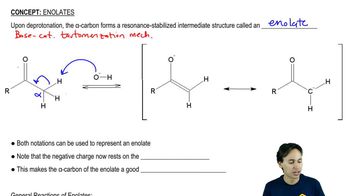
An enolate ion is a resonance-stabilized anion formed from a carbonyl compound, where a hydrogen atom from the alpha carbon is removed by a base. This ion is a key intermediate in many organic reactions, including Claisen condensation, as it acts as a nucleophile, attacking electrophilic carbonyl carbons. Understanding the formation and reactivity of enolate ions is crucial for predicting the outcomes of reactions involving carbonyl compounds.
The products of a Claisen condensation typically contain functional groups such as ketones or β-keto esters, which are characterized by the presence of carbonyl groups (C=O) adjacent to alkyl chains. Analyzing the structure of the desired product helps in determining the appropriate starting materials and reaction conditions. Recognizing how functional groups influence reactivity and stability is essential for successful synthesis in organic chemistry.