Name the following carboxylic acid derivatives, giving both a common name and an IUPAC name where possible. (f) CH3CH(OH)CH2CN
Verified step by step guidance
1
Step 1: Analyze the problem and identify the functional groups in each compound. Carboxylic acid derivatives include esters, amides, and anhydrides. For each compound, locate the functional group and any substituents attached to the main chain or aromatic ring.
Step 2: For compound (a) PhCOOCH2CH(CH3)2, identify the ester functional group. The aromatic ring (Ph) is attached to the carbonyl group, and the alkyl group is isopropylmethyl. Use the common naming convention (alkyl group + benzoate) and the IUPAC naming convention (alkyl benzenecarboxylate).
Step 3: For compound (b) PhOCHO, identify the aldehyde functional group attached to the aromatic ring. The common name is benzaldehyde, and the IUPAC name is benzenecarbaldehyde.
Step 4: For compound (c) PhCH(CH3)COOCH3, identify the ester functional group. The aromatic ring (Ph) is attached to a chain with a methyl substituent and a methoxy group. Use the common naming convention (alkyl group + phenylacetate) and the IUPAC naming convention (methyl 2-phenylpropanoate).
Step 5: For compound (d) PhNHCOCH2CH(CH3)2, identify the amide functional group. The aromatic ring (Ph) is attached to the nitrogen atom, and the alkyl group is isopropylmethyl. Use the common naming convention (alkyl group + benzamide) and the IUPAC naming convention (N-phenyl-2-methylpropanamide).
Verified video answer for a similar problem:
This video solution was recommended by our tutors as helpful for the problem above
Video duration:
3m
Play a video:
Was this helpful?
Key Concepts
Here are the essential concepts you must grasp in order to answer the question correctly.
Carboxylic Acid Derivatives
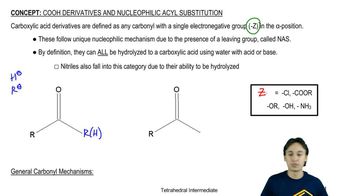
Carboxylic acid derivatives include compounds such as esters, amides, and anhydrides, which are derived from carboxylic acids. They retain the carboxyl functional group (–COOH) but have different substituents replacing the hydroxyl group (–OH). Understanding the structure and reactivity of these derivatives is crucial for naming and synthesizing organic compounds.
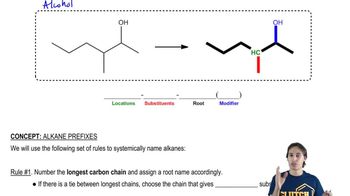
The International Union of Pure and Applied Chemistry (IUPAC) nomenclature provides a systematic method for naming organic compounds. It involves identifying the longest carbon chain, determining the functional groups, and applying specific rules for naming based on the structure. Familiarity with IUPAC rules is essential for accurately naming carboxylic acid derivatives and other organic molecules.
Common names are often simpler and more widely recognized names for compounds, while IUPAC names follow a standardized set of rules. For example, acetic acid is the common name for ethanoic acid. Understanding both naming conventions is important for effective communication in organic chemistry, as different contexts may require different naming styles.