Draw a structure for each of the following: i. 3-methylbutanenitrile
Verified step by step guidance
1
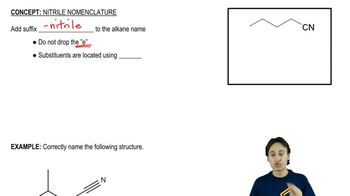
Step 1: Understand the name of the compound. The name '3-methylbutanenitrile' indicates that the compound is a nitrile (contains a -C≡N group) and has a butane backbone (a four-carbon chain). The '3-methyl' prefix means there is a methyl (-CH₃) group attached to the third carbon of the main chain.
Step 2: Start by drawing the main chain. Draw a straight chain of four carbon atoms to represent the butane backbone.
Step 3: Add the nitrile group (-C≡N) to the first carbon of the chain. This is implied because the compound is named 'butanenitrile,' and the nitrile group is always at the end of the chain unless otherwise specified.
Step 4: Place the methyl group (-CH₃) on the third carbon of the chain. Number the carbon atoms in the chain starting from the carbon attached to the nitrile group to ensure proper placement.
Step 5: Verify the structure by ensuring that all carbon atoms have four bonds and that the functional groups and substituents are correctly placed according to the IUPAC name.
Verified video answer for a similar problem:
This video solution was recommended by our tutors as helpful for the problem above
Video duration:
3m
Play a video:
Was this helpful?
Key Concepts
Here are the essential concepts you must grasp in order to answer the question correctly.
Nitriles
Nitriles are organic compounds that contain a cyano group (-C≡N), which consists of a carbon atom triple-bonded to a nitrogen atom. They are derived from carboxylic acids by replacing the -OH group with a -CN group. Nitriles are important in organic synthesis and can be converted into various functional groups, such as amines and carboxylic acids.
Alkyl groups are hydrocarbon substituents derived from alkanes by removing one hydrogen atom. They are characterized by their carbon chain length and branching. In the case of 3-methylbutanenitrile, the '3-methyl' indicates a methyl group attached to the third carbon of a butane chain, which is crucial for determining the compound's structure and properties.
IUPAC nomenclature is a systematic method for naming organic chemical compounds. It provides rules for identifying the longest carbon chain, numbering the chain, and naming substituents. Understanding IUPAC rules is essential for accurately interpreting and drawing chemical structures, such as recognizing that '3-methylbutanenitrile' indicates a butane backbone with a methyl group at the third position and a nitrile functional group.