
Suggest the most appropriate method for each of the following laboratory syntheses. In each case, suggest both a chromium reagent and a chromium-free reagent. (f) 1-methylcyclohexanol → 2-methylcyclohexanone (several steps)
Verified step by step guidance
1
Step 1: Recognize the transformation. The problem involves converting 1-methylcyclohexanol (a secondary alcohol) into 2-methylcyclohexanone (a ketone). This requires oxidation and a shift of the methyl group from position 1 to position 2.
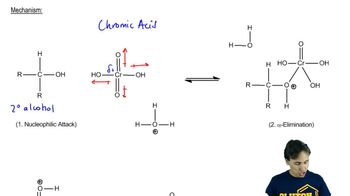
Step 2: Plan the oxidation step. To oxidize the secondary alcohol to a ketone, you can use a chromium-based reagent such as pyridinium chlorochromate (PCC) or Jones reagent (CrO₃ in H₂SO₄). Alternatively, for a chromium-free option, you can use Dess-Martin periodinane (DMP) or Swern oxidation.
Step 3: Consider the methyl group migration. After oxidation, you need to shift the methyl group from position 1 to position 2. This can be achieved through a rearrangement reaction, such as a pinacol rearrangement, which involves acidic conditions to promote the migration.
Step 4: Suggest the chromium-based method. Use PCC or Jones reagent to oxidize 1-methylcyclohexanol to 1-methylcyclohexanone. Then, treat the ketone with an acid catalyst (e.g., H₂SO₄) to induce the methyl group migration, forming 2-methylcyclohexanone.
Step 5: Suggest the chromium-free method. Use Dess-Martin periodinane (DMP) or Swern oxidation to oxidize 1-methylcyclohexanol to 1-methylcyclohexanone. Follow this with the same acid-catalyzed rearrangement to achieve the desired product, 2-methylcyclohexanone.
Verified video answer for a similar problem:
This video solution was recommended by our tutors as helpful for the problem above
Video duration:
7m
Play a video:
Was this helpful?
Key Concepts
Here are the essential concepts you must grasp in order to answer the question correctly.
Oxidation Reactions
Oxidation reactions involve the loss of electrons or an increase in oxidation state by a molecule. In organic chemistry, these reactions are crucial for converting alcohols into carbonyl compounds, such as ketones. Understanding the mechanisms of oxidation helps in selecting appropriate reagents for synthesizing compounds like 2-methylcyclohexanone from 1-methylcyclohexanol.
Chromium reagents, such as chromium trioxide (CrO3) or pyridinium chlorochromate (PCC), are commonly used in organic synthesis for the oxidation of alcohols to carbonyl compounds. These reagents are effective but can be toxic and environmentally hazardous, necessitating careful handling and disposal. Knowledge of their reactivity and selectivity is essential for proposing suitable methods in laboratory syntheses.
Chromium-free oxidation methods, such as using Dess-Martin periodinane or Swern oxidation, provide safer and more environmentally friendly alternatives for converting alcohols to ketones. These methods often have milder reaction conditions and fewer toxic byproducts, making them attractive options in organic synthesis. Familiarity with these alternatives is important for suggesting diverse synthetic pathways.