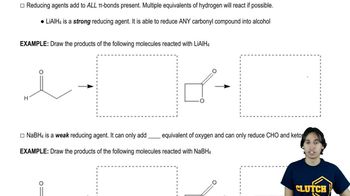
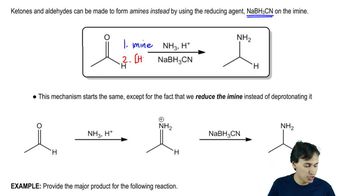
Suggest carbonyl compounds and reducing agents that might be used to form the following alcohols. (e) (f)
Verified step by step guidance
1
Step 1: Analyze the alcohol structures provided. The first structure contains a cyclohexane ring with two hydroxyl groups (-OH), one on the ring and one on a side chain. The second structure contains a cyclohexane ring with a hydroxyl group (-OH) and an ester functional group (-COOCH3).
Step 2: For the first alcohol, identify the precursor carbonyl compound. The hydroxyl group on the side chain suggests that the precursor could be an aldehyde (e.g., CHO group attached to the cyclohexane ring). Reduction of the aldehyde would yield the primary alcohol (-CH2OH).
Step 3: For the second alcohol, identify the precursor carbonyl compound. The ester functional group (-COOCH3) suggests that the precursor could be a ketone (e.g., a carbonyl group adjacent to the ester group). Reduction of the ketone would yield the secondary alcohol.
Step 4: Suggest appropriate reducing agents for the transformations. Common reducing agents for aldehydes and ketones include sodium borohydride (NaBH4) or lithium aluminum hydride (LiAlH4). NaBH4 is milder and typically used for aldehydes and ketones, while LiAlH4 is stronger and can reduce esters as well.
Step 5: Summarize the reaction pathways. For the first alcohol, the aldehyde precursor is reduced to the primary alcohol using NaBH4 or LiAlH4. For the second alcohol, the ketone precursor is reduced to the secondary alcohol using NaBH4 or LiAlH4. Ensure proper reaction conditions (e.g., solvent choice) for each reducing agent.
Verified video answer for a similar problem:
This video solution was recommended by our tutors as helpful for the problem above
Video duration:
5m
Play a video:
0 Comments
Key Concepts
Here are the essential concepts you must grasp in order to answer the question correctly.
Carbonyl Compounds
Carbonyl compounds are organic molecules that contain a carbon atom double-bonded to an oxygen atom (C=O). They include aldehydes and ketones, which are key intermediates in organic synthesis. Understanding the structure and reactivity of these compounds is essential for predicting the products of reduction reactions, where carbonyls are converted into alcohols.
Reducing agents are substances that donate electrons in a chemical reaction, thereby reducing another species. Common reducing agents for carbonyl compounds include lithium aluminum hydride (LiAlH4) and sodium borohydride (NaBH4). The choice of reducing agent can influence the selectivity and efficiency of the reduction process, making it crucial to understand their properties and reactivity.
Reduction reactions involve the gain of electrons or the decrease in oxidation state of a molecule. In organic chemistry, this often refers to the conversion of carbonyl groups to alcohols. Familiarity with the mechanisms of these reactions, including the role of the reducing agent and the conditions required, is vital for successfully synthesizing alcohols from carbonyl compounds.


 5:14 minutes

 Verified step by step guidance
 01:40
01:40