Textbook Question
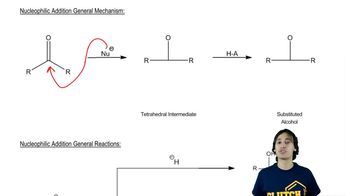
Excess ammonia must be used when a primary amine is synthesized by reductive amination. What product will be obtained if the reaction is carried out with excess carbonyl compound?
1044
views

 Bruice 8th EditionCh. 16 - Reactions of Aldehydes and Ketones • More Reactions of Carboxylic Acid DerivativesProblem 33a,b
 Verified step by step guidance
 08:27
08:27
 2:50
2:50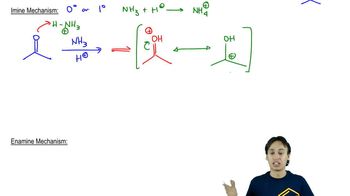 06:23
06:23Excess ammonia must be used when a primary amine is synthesized by reductive amination. What product will be obtained if the reaction is carried out with excess carbonyl compound?
Imines can exist as stereoisomers. The isomers are named using the E,Z system of nomenclature (Section 4.2 ). The lone pair has the lowest priority.
<IMAGE>
Draw the structure of each of the following compounds:
a. the (E)-hydrazone of benzaldehyde
b. the (Z)-oxime of propiophenone
The compounds commonly known as 'amino acids' are actually α-aminocarboxylic-aminocarboxylic acids. What carbonyl compounds should be used to synthesize the two amino acids shown here?
a.
Why is the pKa value of protonated hydroxylamine (6.0) so much lower than the value of a protonated primary amine such as protonated methylamine (10.7)?
The pKa of protonated acetone is about –7.5 and the pKa of protonated hydroxylamine is 6.0.
a. In a reaction with hydroxylamine at pH 4.5 (Figure 16.2), what fraction of acetone is present in its acidic, protonated form?
<IMAGE>
The compounds commonly known as 'amino acids' are actually α-aminocarboxylic-aminocarboxylic acids. What carbonyl compounds should be used to synthesize the two amino acids shown here?
b.