What aldehydes are formed when the following amino acids are treated with ninhydrin? b. leucine c. arginine
Verified step by step guidance
1
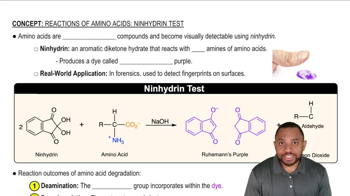
Understand the reaction: Ninhydrin reacts with amino acids to produce aldehydes, carbon dioxide, and ammonia. The aldehyde formed depends on the structure of the amino acid's side chain.
For leucine: Identify the structure of leucine. It has an isobutyl side chain (-CH2-CH(CH3)2). When treated with ninhydrin, the amino group is removed, and the side chain is converted into an aldehyde. The resulting aldehyde will have the structure of the side chain minus the terminal carbon.
For arginine: Identify the structure of arginine. It has a guanidino group (-C(NH2)2-NH) attached to a 3-carbon chain. When treated with ninhydrin, the guanidino group is removed, and the aldehyde formed will correspond to the 3-carbon chain.
Write the general reaction mechanism: Ninhydrin reacts with the amino group of the amino acid, forming a Schiff base intermediate. This intermediate undergoes decarboxylation and hydrolysis to yield the aldehyde.
Determine the specific aldehydes: For leucine, the aldehyde will be isobutyraldehyde (CH3-CH2-CHO). For arginine, the aldehyde will be 3-aminopropanal (H2N-CH2-CH2-CHO).
Verified video answer for a similar problem:
This video solution was recommended by our tutors as helpful for the problem above
Video duration:
1m
Play a video:
Was this helpful?
Key Concepts
Here are the essential concepts you must grasp in order to answer the question correctly.
Amino Acids
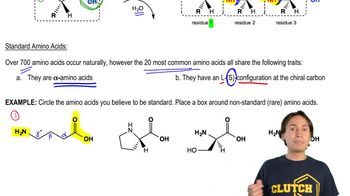
Amino acids are organic compounds that serve as the building blocks of proteins. Each amino acid has a central carbon atom bonded to an amino group, a carboxyl group, a hydrogen atom, and a variable side chain (R group) that determines its unique properties. Understanding the structure and properties of specific amino acids, such as leucine and arginine, is essential for predicting the products formed during chemical reactions.
The ninhydrin reaction is a chemical test used to detect amino acids and proteins. When amino acids react with ninhydrin, they undergo a dehydration reaction, resulting in the formation of a colored complex, typically a purple-blue hue. This reaction not only confirms the presence of amino acids but also leads to the formation of aldehydes, which are important for identifying the specific amino acids involved.
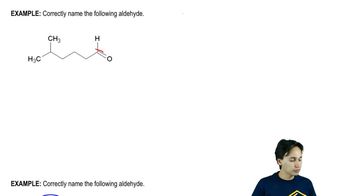
Aldehydes are organic compounds characterized by the presence of a carbonyl group (C=O) bonded to at least one hydrogen atom. In the context of the ninhydrin reaction, the amino acids leucine and arginine are converted into their corresponding aldehydes upon treatment with ninhydrin. Recognizing the specific aldehydes formed from these amino acids is crucial for understanding the outcomes of the reaction and the identification of the amino acids.