Show how you would synthesize the following derivatives from appropriate carbonyl compounds. (c)
Verified step by step guidance
1
Step 1: Identify the target molecule. The structure contains a benzyl group attached to a nitrogen atom, which is part of an imine functional group. The imine is connected to a cyclopentanone derivative. This suggests that the synthesis involves the formation of an imine from a carbonyl compound and an amine.
Step 2: Select the appropriate carbonyl compound. The cyclopentanone group in the target molecule indicates that cyclopentanone should be used as the starting carbonyl compound.
Step 3: Choose the amine for the imine formation. The benzyl group attached to the nitrogen suggests that benzylamine is the appropriate amine to react with cyclopentanone.
Step 4: Perform the imine synthesis reaction. Mix cyclopentanone and benzylamine in the presence of a mild acid catalyst (e.g., p-toluenesulfonic acid) to facilitate the condensation reaction. This will result in the formation of the imine bond between the nitrogen and the carbonyl carbon.
Step 5: Purify the product. After the reaction is complete, isolate the imine derivative by removing excess reactants and byproducts through techniques such as distillation or recrystallization, depending on the physical properties of the product.
Verified video answer for a similar problem:
This video solution was recommended by our tutors as helpful for the problem above
Video duration:
2m
Play a video:
0 Comments
Key Concepts
Here are the essential concepts you must grasp in order to answer the question correctly.
Carbonyl Compounds
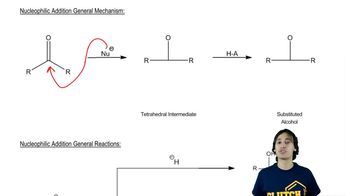
Carbonyl compounds are organic molecules that contain a carbon atom double-bonded to an oxygen atom (C=O). This functional group is pivotal in organic chemistry as it is involved in various reactions, including nucleophilic addition and condensation. Understanding the reactivity of carbonyl compounds is essential for synthesizing derivatives, as they can be transformed into a wide range of functional groups.
Nucleophilic addition reactions occur when a nucleophile attacks the electrophilic carbon of a carbonyl group, leading to the formation of an alcohol or other derivatives. This type of reaction is fundamental in organic synthesis, as it allows for the construction of more complex molecules from simpler carbonyl compounds. Mastery of this concept is crucial for devising synthetic pathways for the desired derivatives.
Synthetic pathways refer to the step-by-step sequences of chemical reactions used to convert starting materials into desired products. In organic chemistry, understanding how to design these pathways is vital for synthesizing specific derivatives from carbonyl compounds. This involves selecting appropriate reagents and conditions to achieve the desired transformations efficiently and effectively.


 2:02 minutes
 Verified step by step guidance
 01:40
01:40