
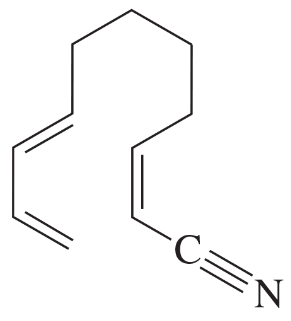
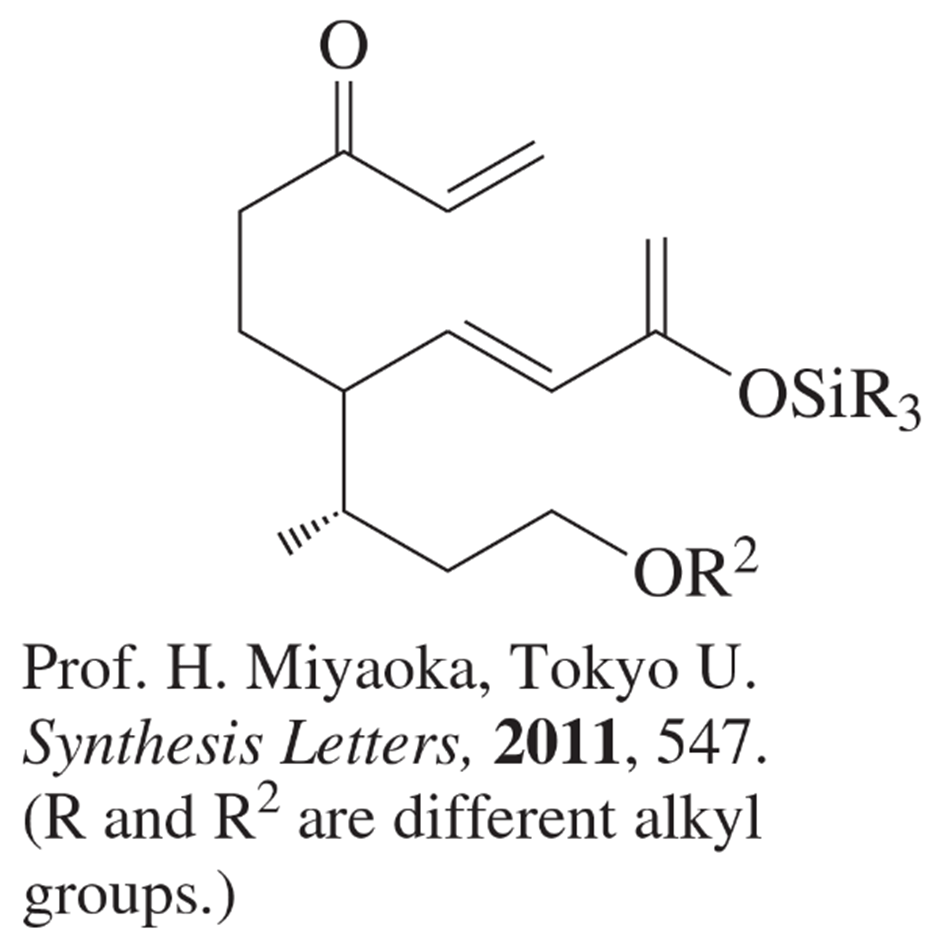
An important variation of the Diels–Alder reaction is intramolecular, in which the diene and the dienophile are connected. This type of Diels–Alder reaction makes two new rings. Draw the compound produced in each of these examples; try to predict stereochemistry (using models will help). In some cases, Lewis acid catalysts are used; that can be ignored for this problem. (a) (b)
Verified step by step guidance
1
Step 1: Analyze the structure provided in the image. The molecule contains a diene (two conjugated double bonds) and a dienophile (an electron-deficient double bond, such as the carbonyl group). These groups are connected within the same molecule, making it suitable for an intramolecular Diels–Alder reaction.
Step 2: Identify the reactive sites. The diene will react with the dienophile to form two new sigma bonds, resulting in the formation of two new rings. The stereochemistry of the product will depend on the orientation of the diene and dienophile during the reaction.
Step 3: Predict the regioselectivity. The electron-withdrawing groups (such as the carbonyl group) on the dienophile will direct the reaction to form the most stable product. Consider the orientation of substituents to minimize steric hindrance and maximize orbital overlap.
Step 4: Draw the product structure. The reaction will form a bicyclic compound. Pay attention to the stereochemistry of the substituents, ensuring that the newly formed rings are correctly oriented based on the original molecule's geometry.
Step 5: Verify the stereochemistry. Use molecular models or visualization tools to confirm the 3D arrangement of the substituents in the product. Ensure that the stereochemistry aligns with the expected outcome of the intramolecular Diels–Alder reaction.
Verified video answer for a similar problem:
This video solution was recommended by our tutors as helpful for the problem above
Video duration:
9m
Play a video:
Was this helpful?
Key Concepts
Here are the essential concepts you must grasp in order to answer the question correctly.
Diels–Alder Reaction
The Diels–Alder reaction is a [4+2] cycloaddition reaction between a conjugated diene and a dienophile, resulting in the formation of a six-membered ring. This reaction is significant in organic synthesis due to its ability to create complex cyclic structures efficiently. Understanding the mechanism, including the roles of orbital overlap and electron density, is crucial for predicting the products and their stereochemistry.
Intramolecular reactions occur when the reactants are part of the same molecule, allowing for a more favorable reaction environment. In the context of the Diels–Alder reaction, this means that the diene and dienophile are connected, leading to the formation of multiple rings in a single step. This concept is essential for visualizing the spatial arrangement of atoms and predicting the resulting stereochemistry.
Stereochemistry refers to the study of the spatial arrangement of atoms in molecules and how this affects their chemical behavior. In the Diels–Alder reaction, the stereochemical outcome is influenced by the orientation of the diene and dienophile during the reaction. Understanding stereochemistry is vital for predicting the configuration of the product, especially in cases where chiral centers are formed.