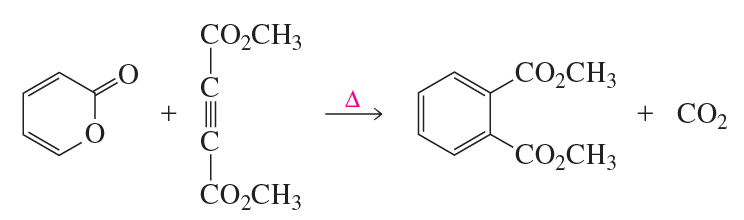
Show the steps involved in the following reaction:
Verified step by step guidance
1
Identify the type of reaction: Determine whether the reaction is a substitution, elimination, addition, or another type of organic reaction. This will help guide the mechanism and reagents involved.
Analyze the reactants and reagents: Examine the structure of the starting material and the reagents provided. Consider functional groups, stereochemistry, and any specific conditions (e.g., heat, solvent) that might influence the reaction.
Propose the reaction mechanism: Break down the reaction into individual steps, such as bond breaking and bond forming. Use curved arrows to show the movement of electrons. For example, if it is a nucleophilic substitution, identify the nucleophile, electrophile, and leaving group.
Determine the intermediate(s): If the reaction involves intermediates (e.g., carbocations, carbanions, or radicals), identify their structure and stability. Consider factors like resonance, hyperconjugation, and inductive effects that stabilize or destabilize intermediates.
Predict the product(s): Based on the mechanism and intermediates, deduce the final product(s). Ensure that you account for stereochemistry (e.g., cis/trans, R/S configurations) and regiochemistry (e.g., Markovnikov or anti-Markovnikov addition) if applicable.
Verified video answer for a similar problem:
This video solution was recommended by our tutors as helpful for the problem above
Play a video:
Was this helpful?
Key Concepts
Here are the essential concepts you must grasp in order to answer the question correctly.
Reaction Mechanism
A reaction mechanism is a step-by-step description of how a chemical reaction occurs at the molecular level. It outlines the sequence of elementary steps, including bond breaking and forming, and the movement of electrons. Understanding the mechanism is crucial for predicting the products and the conditions required for the reaction.
Reagents are the substances that undergo a chemical change in a reaction, while conditions refer to the environment in which the reaction takes place, such as temperature, pressure, and solvent. Identifying the correct reagents and conditions is essential for successfully carrying out a reaction and achieving the desired products.
Stereochemistry is the study of the spatial arrangement of atoms in molecules and how this affects their chemical behavior. In reactions, the stereochemistry can influence the outcome, including the formation of stereoisomers. Understanding stereochemistry is vital for predicting the properties and reactivity of the products formed in a reaction.